
To choose the right bot management solution, evaluate four criteria: detection architecture (edge or origin-side), signal telemetry (JA3/JA4 TLS fingerprinting, behavioural heuristics), integration with your WAF and API layer, and control over AI crawlers. Then price the factor nobody quotes: the engineering time to keep it tuned. The right choice holds protection without raising false positives on legitimate mobile and web traffic.
What bot management solutions actually do
Bot management solutions filter automated traffic before it reaches your origin. Automated traffic is not one population but two, and they need opposite treatment: bots you depend on (search engine crawlers, uptime monitors, payment and partner integrations) and bots that cost you money (credential stuffing tools, scraping engines, inventory hoarding scripts). A solution that cannot tell them apart will either block revenue or admit abuse.
Effective solutions operate through three distinct operational phases:
- Detection: Identifying non-human actors using network characteristics, TLS handshakes, HTTP request headers, device attributes, and real-time execution heuristics.
- Scoring: Assigning a threat or bot score to each incoming request based on cumulative signal anomalies rather than isolated binary rules.
- Action: Enforcing a policy response, ranging from silent log-mode observation and request header injection to JavaScript challenges, rate-limiting, dynamic honeypots, or outright dropping connection resets.
The job is to stop advanced tooling without adding latency or breaking the customer journey.
The four criteria that separate solutions
Platforms differ less in what they claim than in where they inspect and what they leave you to operate. Four criteria surface those differences before deployment rather than after.
1. Detection architecture and point of enforcement
Solutions fall into two primary architectural models:
- Edge-Native Network In-Line: Protection runs directly within a distributed Anycast CDN edge. Inspection occurs before traffic reaches origin infrastructure, terminating threat requests at the edge.
- Origin-Side / API Reverse Proxy: Traffic is routed through dedicated third-party scrubbing centres or inspected via origin web server plugins, sidecars, or API connectors.
Edge-native architectures eliminate backhaul latency and absorb volumetric layer 7 attacks before they hit application servers. Reverse-proxy connectors can introduce point-to-point network hops or burden origin compute resources during high-volume incidents.
2. Telemetry breadth and signal sophistication
Legacy bot mitigation relied on static user-agent strings, IP address reputation databases, and basic rate limits. Sophisticated attackers bypass these controls using residential proxy networks, headless browser orchestration, and replayed mobile app TLS parameters.
Modern platforms must evaluate:
- Cryptographic Fingerprinting: Analysing JA3/JA4 TLS signatures to identify underlying HTTP clients regardless of user-agent spoofing.
- Behavioural Analysis: Detecting unnatural navigation patterns, timing cadence, mouse dynamics, and API access sequences across user sessions.
- Client-Side Telemetry: Injecting lightweight, unobtrusive JavaScript signals to detect headless environments, automation frameworks (Selenium, Puppeteer, Playwright), and virtualised browser instances.
3. Native integration capabilities
Bot management does not operate in isolation. Evaluated platforms have to pass context to the adjacent security layers:
- Web Application Firewalls (WAF): Passing bot scores into custom WAF rules to restrict specific endpoints (such as login forms or search APIs) when bot probability crosses defined thresholds. Where bot, WAF and API controls are bought and operated as one layer, the result is a managed WAAP service rather than three tools to reconcile.
- API Security Layers: Enforcing schema validation and blocking automated traffic on non-browser endpoints, such as native iOS and Android application APIs.
- Identity and Session Monitoring: Mitigating account takeover protection risks by identifying credential stuffing attempts on authentication routes.
4. AI crawler and LLM scraper controls
Generative AI changed what scraping is for. Classic bot mitigation targeted tools that degraded performance or committed fraud. The question now also covers autonomous AI crawlers, retrieval-augmented generation (RAG) scrapers, and model-training bots harvesting proprietary content without authorisation. Most platforms added their answer late, so this is where capability gaps concentrate. Four things to assess.
Verification beyond the declared user-agent. Well-behaved crawlers identify themselves (GPTBot, ClaudeBot, PerplexityBot) and honour robots.txt. Aggressive aggregators do neither: they present browser signatures and route through commercial residential proxy networks. A robots directive is a request, not a control. Ask how the platform identifies a crawler that lies, and whether it recognises that crawler on its next visit.
Separation from search crawlers. All-or-nothing controls are useless here. Blocking GPTBot costs you nothing in search; blocking Googlebot removes you from Google. A platform that cannot separate the two forces a choice nobody should have to make.
Granularity of action. Block-or-allow is rarely enough. Look for selective blocking by path, so proprietary data is closed while search crawlers keep indexing; rate limiting, to cap origin cost without severing indexing entirely; and honeypot or synthetic-content responses for crawlers that ignore every other signal.
Classification update cadence. New models and agent frameworks appear continuously, and a platform is only as good as the freshness of its classification. Ask how new crawlers get identified, and whether that happens centrally across the vendor's network or requires an administrator to write a rule each time.
On Cloudflare these controls are named and separable: Block AI Bots as a managed setting, AI Labyrinth for crawlers that ignore robots.txt, and AI Crawl Control for granular per-crawler allow and block decisions with analytics.
One caution that vendors rarely raise, because it cuts against the sale: blocking AI crawlers wholesale also removes you from the answers those engines generate. If you sell to buyers who now start their research in an AI assistant, the right policy is selective, not maximal. Decide it per hostname, protecting the application while leaving the marketing surface readable.
Solution family matrix
Bot mitigation vendors fall into three delivery families. The matrix below sets out the structural trade-offs of each.
| Architectural Family | Edge-Integrated WAAP Platforms | Specialised Pure-Play Anti-Bot Vendors | Origin Plugin / Agent Models |
|---|---|---|---|
| Representative vendors | Cloudflare Bot Management, Akamai Bot Manager, Imperva Advanced Bot Protection, Fastly Bot Management | DataDome, HUMAN Security, Fingerprint | Self-managed WAF modules, reverse-proxy and sidecar deployments (ThreatX and comparable) |
| Deployment Model | Global Anycast Edge Network | Scraper / API Redirection or SDK | Web Server Module / Sidecar |
| Protection Scope | WAF, DDoS, API, Bot, CDN combined | Advanced Bot & Fraud Focus | Local Application Endpoint |
| Latency Profile | Zero added latency (integrated edge) | Added round-trip time (RTT) for scrubbing | Local compute overhead |
| Mobile API Defence | TLS Fingerprinting + Edge Rules | Native Mobile SDK Integration | Payload Analysis / Connector |
| Primary Advantage | Unified operational plane; zero backhaul | Deep specialised behavioural modelling | Low initial procurement hurdle |
| Operational Trade-off | Requires domain edge delegation | Multi-vendor policy orchestration | Scale limited by origin resources |
Vendors are grouped by delivery architecture, not by capability ranking. Several operate across more than one model, and product lines are renamed often enough that the vendor's own current documentation should be treated as the reference over any third-party table, including this one.
Where we sit: Brixio is an Authorized Cloudflare Service Delivery Partner and operates Cloudflare exclusively. We deploy and run one of the platforms in the first column, which is worth knowing when you read the rest of this article. What follows on operational cost comes from running that platform in production, not from evaluating the others.
Decision paths: matching architecture to infrastructure context
Criteria on their own do not decide anything. Three constraints do: infrastructure footprint, operational resources, and application endpoint exposure.
Most organisations sit on more than one of these paths at once. Where they conflict, resolve in this order: the constraint you cannot engineer your way out of wins. A missing security team is a harder limit than an inconvenient architecture, because the second can be bought and the first cannot be improvised.
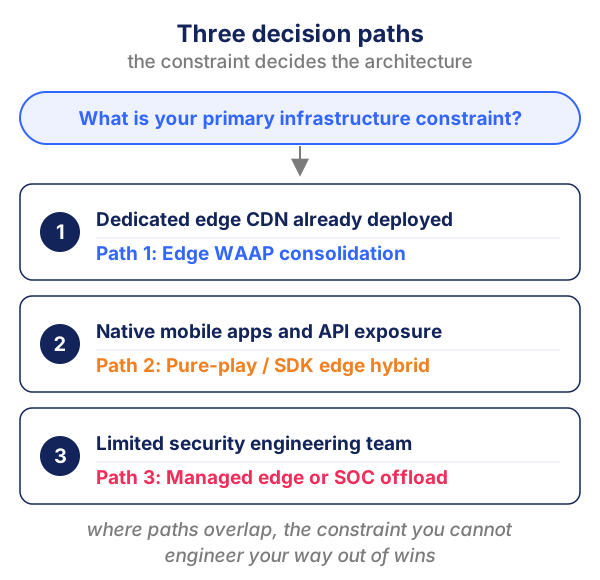
Path 1: You already operate behind an integrated edge network
Primary constraint: operational simplicity and zero latency degradation.
Architectural choice: edge-integrated WAAP platform.
Decision logic: if your domain DNS and TLS termination already route through an edge network (such as Cloudflare or Akamai), selecting an edge-native bot tier eliminates multi-vendor backhaul latency and avoids redundant request inspection. Enforcement occurs at the edge boundary, before origin compute is consumed. The practical test is whether you would be adding a second inspection hop to traffic that already passes through one.
Path 2: Your core vulnerability lies in native mobile APIs
Primary constraint: automated fraud on headless endpoints where browser challenges cannot execute.
Architectural choice: pure-play vendor with native SDKs, or custom edge inspection.
Decision logic: the browser challenge, which carries most of the enforcement on web traffic, is unavailable to you here (see the engineering section below for why). That removes the cheapest control from the table, so the selection has to be made on signal quality instead. Prioritise platforms offering deep mobile client SDK telemetry, or custom edge rule engines able to verify device integrity, TLS JA3/JA4 signatures and API cadence without user friction.
Beware of scoring demonstrations run against browser traffic: they tell you nothing about this case.
Path 3: You lack a dedicated security engineering team
Primary constraint: limited SOC bandwidth to manage false positives and rule updates.
Architectural choice: fully managed pure-play vendor, or managed edge services.
Decision logic: if internal engineering cannot allocate weekly cycles to audit logs, adjust scoring thresholds, and maintain endpoint whitelists, an unmanaged platform will drift. Ask for a documented false-positive target, a named review cadence, and who carries the tuning work. Contractual false-positive guarantees are rare in this market; a written operating target with an owner is the realistic equivalent, and its absence is the signal to watch for.
When the platform stops and engineering starts
Default configurations handle the common cases. Business logic abuse, unusual API structures and hybrid mobile estates are where they stop.
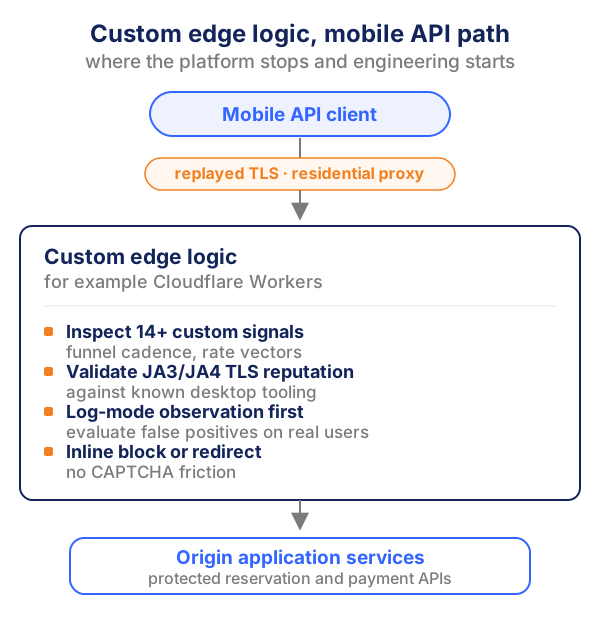
Mobile is the clearest example, and it compounds: with no browser challenge available, fingerprint reputation carries more weight, which is exactly what attackers target. They extract the mobile client's own parameters and replay legitimate Android or iOS JA3/JA4 signatures from desktop tooling behind residential proxies. The remaining signal is behavioural, and reading it takes code.
This is not a hypothetical. On an airline booking platform, the web channel was locked down and the abuse simply moved to the mobile-app API, where the WAF had nothing to inspect and no challenge could be rendered. We built the enforcement layer as custom edge logic on Cloudflare Workers, ran it in observation mode first, then switched it inline. The full account is published as the Bot Shield airline case study.
FIELD PROOF
North African airline
On an airline booking platform, locking the web channel down simply moved the abuse to the mobile-app API, where no browser challenge could render. Stopped with custom edge logic, no CAPTCHA, zero false positives.
In critical application environments, addressing targeted abuse requires executing custom detection logic directly at the network edge:
The cost nobody quotes: quantifying operational overhead
Procurement evaluations routinely focus on annual licensing costs while ignoring internal engineering expenditure. In production, holding detection accuracy without blocking legitimate users is a standing maintenance commitment, not a deployment task.
Baseline targets
On the zones we operate, the targets are these: false positives below 0.1% overall, below 0.05% on critical form endpoints such as login and payment submission, and more than 95% of definitively automated traffic mitigated without manual IP blacklisting. A documented exception list is reviewed monthly.
Those are operating targets we hold ourselves to, not an industry standard. Their value to you is as a reference point when a vendor declines to state any number at all.
What drives the hours
The figures in this section are orders of magnitude drawn from the zones we run, not a quote. Every one of them moves with the real shape of a project: how often you release, how many endpoints you expose, how much partner and corporate traffic has to be whitelisted, and how contested your sector is. Use them to argue against the assumption that a bot platform costs nothing to keep, then size against your own environment.
For a typical enterprise footprint (a marketing domain, dynamic checkout routes, and roughly 10 to 15 public API endpoints), a mature deployment runs somewhere between 15 and 30 endpoint-specific scoring rules. Applying one global sensitivity setting across all of it is the single most common cause of false positives on non-standard client traffic.
The maintenance splits three ways.
Weekly, after releases (1 to 2 hours). Inspect blocked request logs following application releases and frontend campaigns. New client-side frameworks and mobile app updates change baseline headers, which shows up as a false spike in threat scores. A team shipping daily will spend more time here than one shipping monthly.
Monthly, exception drift (4 to 8 hours). Corporate proxy ranges, regional ISP routing and partner API integrations move. Whitelists and bypass conditions need pruning, both to remove stale entries and to close the silent bypasses they create. The range widens with the number of partner integrations in place.
Quarterly, recalibration. Rule parameters degrade as toolkits adapt and ASN ranges rotate, on the order of 90 to 120 days before a visible drop in precision.
Skip this lifecycle and there are only two outcomes: sensitivity gets lowered until the tool stops doing anything, or support absorbs a permanent stream of blocked-customer escalations. Our production tuning guide for Cloudflare Bot Management sets out what the rule work looks like endpoint by endpoint on one platform.
Understanding commercial pricing structures
Vendor proposals are hard to compare because the meters differ. Three models dominate, and each fails in a different place as traffic scales.
Request metering, charged per million inspected requests. Cost tracks total traffic. The exposure is that a volumetric layer 7 attack or a scraper surge inflates the bill even though the requests were blocked at the perimeter: you pay to reject the traffic you bought the product to reject.
Check whether the agreement caps billable requests during a confirmed attack.
Flat rate per domain or hostname, usually with bandwidth caps. Predictable, which is its whole appeal. The exposure is feature gating: advanced telemetry, custom edge execution and deep API payload inspection are frequently held back for higher tiers, so the predictable price buys a narrower product than the demonstration suggested.
Bundled into a WAAP or CDN contract. Lowest incremental cost and one invoice. The exposure is that bundling can mask capability gaps against specialist vendors, typically in mobile SDK telemetry depth or in how quickly niche AI crawlers get classified.
When modelling total cost of ownership over three years, run the numbers against peak events rather than baseline averages. A contract that becomes most expensive precisely when you are under attack is mispriced for your risk.
Navigating platform migration: costs and risks
Replacing an incumbent platform carries temporary risk that rarely appears in the business case. Three costs are routinely missed.
Signal history is not portable. Behavioural scoring rests on months of accumulated telemetry: IP reputation, fingerprint histories, session cadence baselines. None of it transfers. The replacement arrives with no context on what your legitimate traffic looks like, which is exactly the context that keeps false positives down.
A parallel observation phase is mandatory, not optional. The new platform has to run in passive log mode before enforcement, on the order of 14 to 30 days, longer where traffic is seasonal and the baseline needs to cover a full commercial cycle. Two costs land in that window: licences overlap because the incumbent contract stays live, and engineering spends cycles cross-referencing detection logs between both products to find the discrepancies before switching enforcement.
Changing architectural family means changing plumbing. Moving from an origin-side agent to an edge-integrated platform means DNS propagation, TLS certificate provisioning and API route definitions all get reworked. Mobile deserves separate planning: if the incumbent relied on an embedded client SDK, app store releases have to ship weeks ahead of contract expiry, and app store review time is not under your control.
Schedule the transition outside peak commercial periods, and hold passive observation until false positives on critical endpoints sit inside the targets above.
Where to start
Two starting points, depending on where you are.
If you already run a platform and want to know what your current configuration actually covers, a Cloudflare security audit is read-only, non-intrusive, and returns a scored posture against your live zones rather than a questionnaire.
If the selection is made and the work is the deployment, the tuning and the exception list that follows, that is Cloudflare professional services: scoping, rollout in observation mode, then enforcement once the false-positive baseline holds.
Questions and answers
A bot management solution filters automated web traffic. It protects web applications, APIs and mobile endpoints against credential stuffing, content scraping, account takeover and automated inventory hoarding, without blocking legitimate crawlers and users. In procurement terms, this is what buyers describe as credential stuffing protection, web scraping protection, and account takeover protection: three names for three distinct abuse patterns, rarely covered to the same depth by the same product.
A standard Web Application Firewall (WAF) inspects individual requests against static signature rules to block known vulnerability exploits (such as SQL injection or cross-site scripting). Bot mitigation focuses on intent and behavior, evaluating request patterns, client environment heuristics, and session cadence across multiple requests to distinguish human users from automated scripts.
Yes. Mobile API endpoints cannot render traditional visual challenges without degrading application functionality. Protection relies on cryptographic TLS fingerprinting (JA3/JA4), request cadence analysis, dynamic rate-limiting, and lightweight client SDKs or custom edge inspection logic that detect automation without interrupting the native application workflow.
Log mode runs detection rules in passive observation without blocking traffic, allowing security teams to analyse signal accuracy, verify baseline behavior, and eliminate false positives on real users. Block mode enables active enforcement, dropping or challenging requests that cross defined threat thresholds once policies are validated.