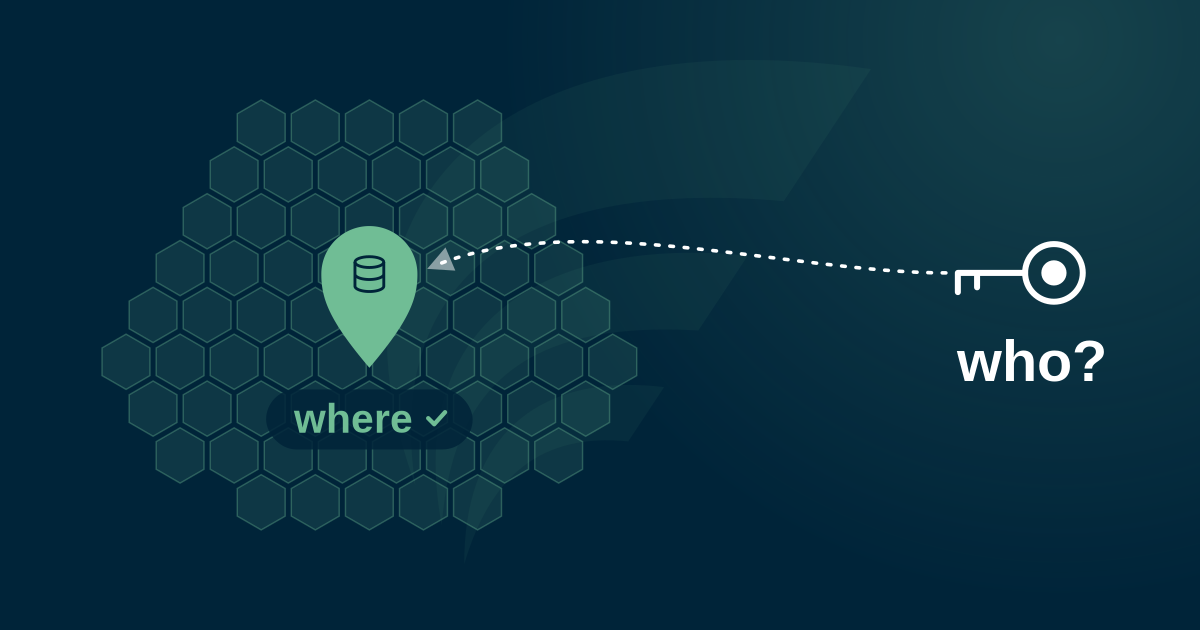
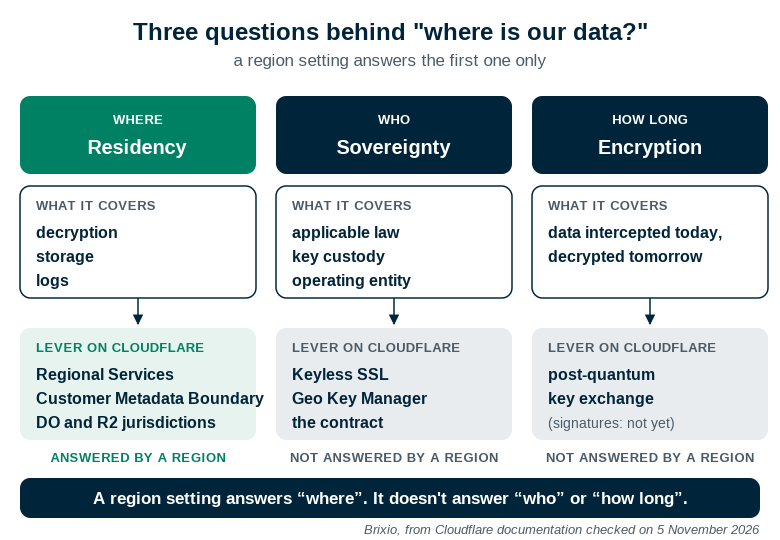
A regulator, an auditor or a public tender asks one question: where is our data? It hides three. Where is it decrypted, stored and logged? Under whose law, and who holds the keys? And will today's encryption still protect it in ten years? A region setting answers the first one only.
Data residency is where data is physically stored and processed. Data sovereignty is which country's law governs that data, and who can be compelled to hand it over. A provider sets residency with a region; sovereignty also depends on who holds the encryption keys, where logs are kept and which company runs the service.
This article answers those three questions for Cloudflare, product by product and region by region, including what was announced at Connect 2026. For the platform as a whole, see our Cloudflare One page.
Statuses and regions checked on 5 November 2026 against Cloudflare's documentation. Data Residency Architecture is in private beta: we update this article when it changes.
What is the difference between data sovereignty and data residency?
Three notions are often used interchangeably. They answer different questions, and different people decide them.
| Notion | Question | Who decides | What proves it | Lever on Cloudflare |
|---|---|---|---|---|
| Residency | where is the data stored and processed? | your organisation, by choice or by contract | the provider's configuration and documentation | Regional Services, Customer Metadata Boundary, Durable Objects and R2 jurisdictions |
| Localisation | does the law require it to stay in the country? | the legislator | the applicable text, read by your lawyer | the same, if the region exists |
| Sovereignty | whose law applies, and who can be compelled to hand it over? | the law of the country and that of the provider | key custody, log location, contract, operating entity | Keyless SSL, Geo Key Manager, Customer Metadata Boundary |
The difference shows up with extraterritorial law. The US CLOUD Act allows US authorities to require a provider subject to US law to produce data it holds, wherever that data is stored. Cloudflare is a US company. A region setting changes neither the company that processes the data nor the law that applies to it.
Sovereignty is therefore handled through who holds the keys (Keyless SSL, Geo Key Manager), where the logs are kept, and the contract, not through the region alone.
A region setting answers "where". It doesn't answer "who".
Our glossary gives standalone definitions of data residency and data sovereignty.
What do you have to prove to a regulator?
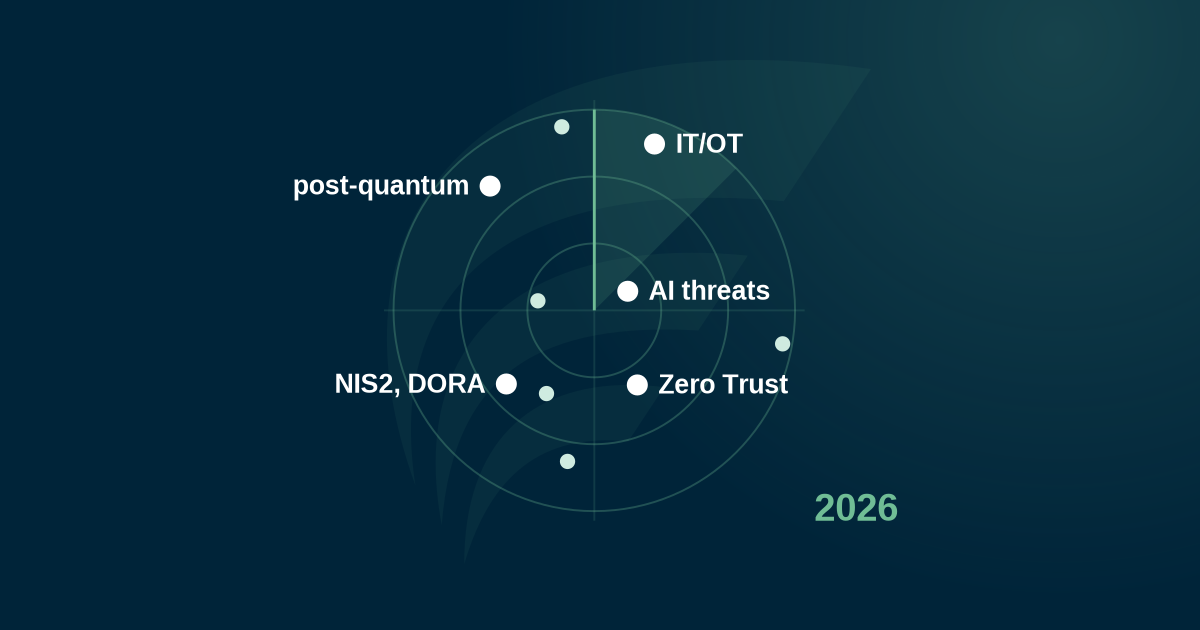
Data residency requirements differ by text: the GDPR (General Data Protection Regulation), NIS2 and DORA (Digital Operational Resilience Act) in the European Union, national data protection laws in the United Arab Emirates and Saudi Arabia. Reading them is your lawyer's job. What a network provider must let you document comes down to four points:
- Where traffic is decrypted and inspected.
- Where logs and metadata are stored.
- Where the private keys are, and who can use them.
- Which flows escape those settings.
Since 29 October 2026, a Data Localization Suite overview in the Cloudflare dashboard shows the account's Regional Services, Customer Metadata Boundary and Geo Key Manager settings on one read-only page, which helps document the first three points.
Here is what Cloudflare lists on its compliance page, consulted on 5 November 2026: ISO/IEC 27001:2022, 27701, 27018 and 27017, SOC 2 Type II, C5:2020, ENS, the EU Cloud Code of Conduct (a code approved under Article 40 of the GDPR) and certification under the EU-U.S. Data Privacy Framework. SecNumCloud qualification does not appear on Cloudflare's compliance page (consulted on 5 November 2026), and neither does any Emirati or Saudi certification.
NIS2 and DORA set obligations for your organisation; neither is a certificate a provider can hold. Our pages on NIS2 and DORA cover what they mean for your security programme, and our glossary defines the GDPR.
What can Cloudflare keep in the EU or in the Gulf today?
The Data Localization Suite is purchased on Enterprise contracts and enabled by your account team. It groups three components: Regional Services, Customer Metadata Boundary and Geo Key Manager.
| Feature | What it localises | EU, France, Switzerland | UAE, Saudi Arabia | Status |
|---|---|---|---|---|
| Regional Services | decryption and inspection of HTTPS traffic | EU, mainland France, Switzerland, Germany, Schengen area and others | UAE, Saudi Arabia (no Qatar, Bahrain, Kuwait or Oman) | available, Data Localization Suite (Enterprise) |
| Customer Metadata Boundary | logs and metadata | EU | no region: EU or US only | available, Data Localization Suite |
| Geo Key Manager | TLS private keys | EU; Germany and UK in version 2 only; neither France nor Switzerland | none | available for custom certificates; the documentation describes version 2 both as current and as closed beta |
| Keyless SSL | the private key stays on your own infrastructure, in a hardware security module (HSM) that holds and uses the key without exposing it | wherever you host it | wherever you host it | available, Enterprise, paid add-on |
| Durable Objects | execution and storage of an object | eu jurisdiction | none (eu, us, fedramp) | available |
| R2 | stored objects | eu jurisdiction | none (eu, us, fedramp) | available |
| Data Residency Architecture | control plane, logs, Workers, rules | not published | not published | private beta |
For the Gulf, the table reads like this: HTTPS decryption can stay in the UAE or Saudi Arabia, through Regional Services; logs, however, can only stay in the EU or the US, through Customer Metadata Boundary. No Qatar, Bahrain, Kuwait or Oman region is published. Cloudflare does list data centres in Dubai, Riyadh, Jeddah, Dammam and Doha on its network page, but a data centre is not a residency region.
For France and Switzerland: both have published Regional Services regions. Logs stay in the EU or the US only, with no Swiss region, and Geo Key Manager offers neither a France nor a Switzerland region.
On the developer platform, Durable Objects and R2 accept an eu, us or fedramp jurisdiction.
If your logs must stay in the Gulf, Customer Metadata Boundary won't do it: it offers the EU or the US only. Plan a Logpush export to storage you control, and ask your account team where logs are processed before export.
How these mechanisms combine into a full architecture is covered on data sovereignty on Cloudflare.
Does data residency extend to Cloudflare One?
Partly. Cloudflare One is Cloudflare's platform for securing employees' access: Gateway filters their web traffic, Access controls their access to applications.
On Cloudflare One, a Gateway processing region keeps HTTPS decryption and inspection in a chosen region, such as the EU, for supported on-ramps: the Cloudflare One Client, Cloudflare Mesh and Cloudflare WAN (IPsec, GRE or Direct CNI). DNS and network policies are still processed in the data centre that receives the traffic. Since 30 October 2026, traffic from sites connected through Cloudflare WAN stays encrypted until it reaches the selected region, where Gateway decrypts it; this requires unified routing (changelog).
The region is set up with your Cloudflare account team. The published regions are the European Union, the Schengen Area, the United States, FedRAMP Moderate (domestic and international), IRAP Protected, NATO, "Exclusive of Hong Kong and Macau" and "Exclusive of Russia and Belarus"; other regions can be discussed with the account team. Neither the UAE, Saudi Arabia, France nor Switzerland is in the published list.
Other products follow their own rules, according to Cloudflare's data residency documentation for Cloudflare One:
| Product or flow | Documented behaviour |
|---|---|
| Gateway, HTTP inspection | chosen processing region (published regions above; others on request) |
| Gateway, DNS and network policies | processed in the data centre that receives the traffic |
| Cloudflare WAN | encrypted until the chosen region, then decrypted by Gateway (since 30 Oct 2026) |
| Access, team domain | FedRAMP Moderate (Domestic) only |
| Browser Isolation | US FedRAMP region only |
| CASB (cloud access security broker) | neither Regional Services nor Customer Metadata Boundary |
| File Sandboxing | processed in the US |
| DLP (data loss prevention) | not supported in regional processing: exact data match (EDM), custom wordlists, document entries, AI prompt topics, patterns with custom functions, AI context analysis and OCR (optical character recognition) |
| Tunnel and Client connection points | Earth, US or FedRAMP High |
If you use Gateway Forward, add the Worker it calls to your data flow map.
The wider Zero Trust architecture is covered in SASE and Zero Trust, and the platform's limits in where Cloudflare One stops.
Map your data flows on Cloudflare →
What did Cloudflare announce at Connect 2026 on data residency?
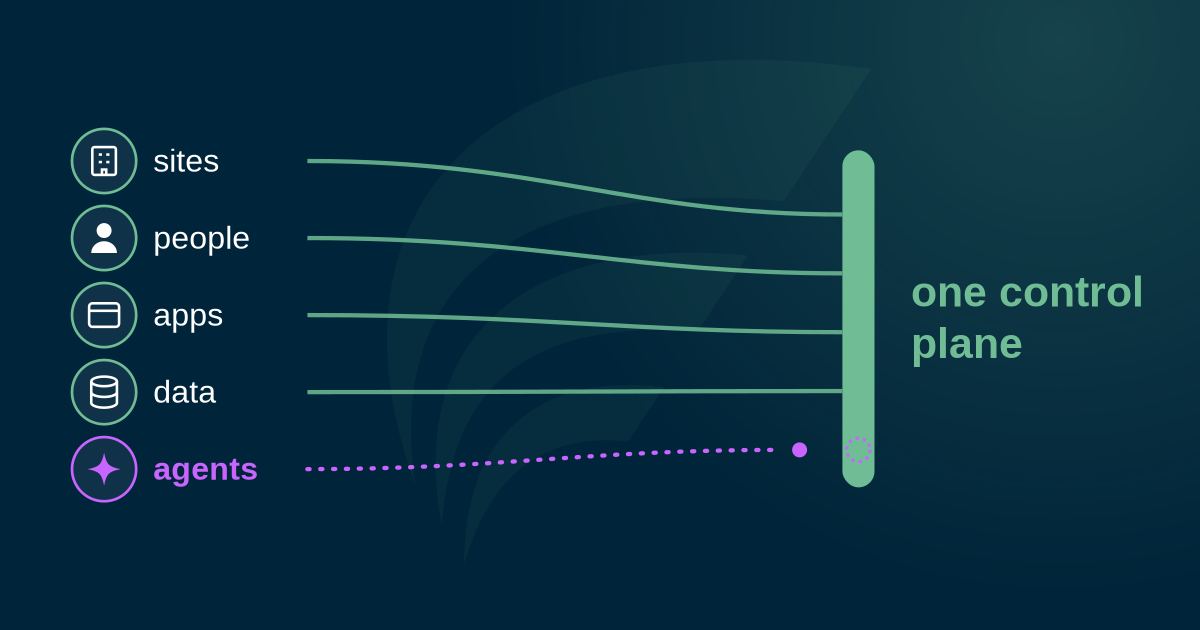
Stephanie Cohen, Cloudflare's chief strategy officer, summed up the direction at the keynote on 20 October 2026 as "Region: Earth": deploy once, then choose where data is processed, stored and logged, with "global availability with local control".
At Connect 2026, Cloudflare presented a Data Residency Architecture, in private beta, which rebuilds its control plane and logging on Workers and Durable Objects so that a Worker, a rule or a Durable Object can be pinned to a jurisdiction. According to Cloudflare on stage, logs then stay where they need to be, "with a click". Applications go through a public form; no regions, offer or availability date have been published.
On stage, Cloudflare also described its approach to sovereignty: data encrypted until it arrives in the country, and control over where the keys are kept. An on-premises appliance was described as "highly, highly unlikely".
| Available today | Private beta | Not available today (according to Cloudflare, Connect 2026) |
|---|---|---|
| Data Localization Suite: Regional Services, Customer Metadata Boundary, key location (check product by product) | Data Residency Architecture: control plane and logs placed where they need to be | Workers AI inference pinned to a country or region |
| Durable Objects and R2 jurisdictions | an auditable list of processing locations for a regulator | |
| post-quantum key exchange on Cloudflare One on-ramps | guaranteed blocking if the chosen region is unavailable | |
| encryption until the chosen region (Cloudflare WAN, 30 Oct 2026) | offline operation, on-premises appliance |
Some of these limits can be worked around with engineering on Workers, for example keeping state in the EU with a Durable Objects jurisdiction. Others cannot, such as offline operation or an on-premises appliance. Knowing which is which is part of the file.
Where does post-quantum encryption fit in a sovereignty plan?
Data intercepted today can be decrypted later by a quantum computer, an attack known as "harvest now, decrypt later". How long your data must stay confidential is therefore part of the sovereignty question. Our post-quantum readiness page covers it in detail.
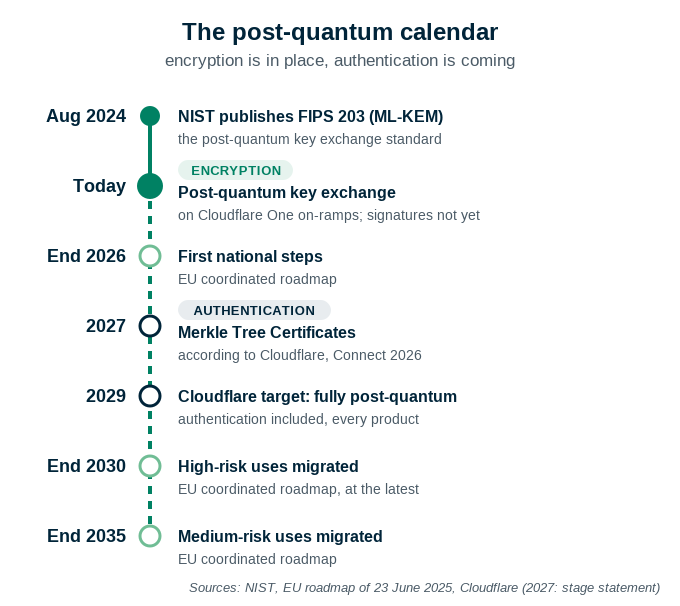
According to Cloudflare at Connect 2026, all Edge, CDN and Cloudflare One on-ramps are encrypted with post-quantum cryptography today; Merkle Tree Certificates are expected in 2027; and post-quantum encryption and authentication should cover every product by 2029.
What Cloudflare has published: a target of 2029 for full post-quantum security, authentication included (roadmap post, April 2026), and an experiment with Chrome on Merkle Tree Certificates (October 2025). The 2027 date does not appear in any public source we found, so it remains a statement from the stage.
On Cloudflare One, the status per on-ramp is as follows (documentation):
| On-ramp | Key exchange | Signatures |
|---|---|---|
| Cloudflare One Client (MASQUE) | X25519MLKEM768 | not yet |
| Cloudflare Tunnel | X25519MLKEM768 | not yet |
| IPsec, third-party devices | ML-KEM-768 and ML-KEM-1024 (validated with Fortinet FortiOS 7.6.6 and later; with Cisco 8000 on IOS XR 26.1.1, ML-KEM-1024) | not yet |
| Cloudflare One Appliance | X25519MLKEM768 from version 2026.2.0 | not yet |
| Clientless access and secure web gateway | post-quantum up to Cloudflare; to the origin only if the destination supports it | not yet |
The key exchange, which protects confidentiality, is done. The signatures, which prove the identity of the server, are not yet. And between Gateway and the destination site, encryption is only post-quantum if the destination supports it.
As a public measure, around 71% of HTTPS requests were encrypted with post-quantum cryptography on Cloudflare Radar over the seven days to 5 November 2026. The figure moves; check it on the day you read this.
The reference texts are the NIST FIPS 203 standard (ML-KEM), published on 13 August 2024, and the coordinated EU roadmap for the post-quantum transition of 23 June 2025: first national steps by the end of 2026, high-risk uses migrated by the end of 2030 at the latest, medium-risk uses by the end of 2035. Our glossary defines post-quantum cryptography.
How do you build a sovereignty file that holds up?
- Map the flows product by product: proxy and WAF (web application firewall), Cloudflare One, Workers, AI.
- Choose the region for each product from the published lists, and note the products that have none.
- Decide on key custody: Keyless SSL (key on your HSM) or Geo Key Manager (published regions).
- Set the log location: Customer Metadata Boundary (EU or US), or a Logpush export to storage you control. Check with your account team where logs are processed before export.
- For Cloudflare One, request the Gateway processing region and document what is still processed at the on-ramp (DNS and network policies).
- Check post-quantum status for each on-ramp and on your origins.
- Write down the gaps, with an owner and a review date. Review again when Data Residency Architecture leaves beta.
Write down the flows that no region setting covers (DNS and network policies, CASB, sandboxing) before your auditor finds them. A documented gap with an owner reads very differently from a gap discovered during an audit.
At Brixio, we map these flows product by product and record the gaps in writing, before deployment. We have delivered 450+ projects, are certified ISO/IEC 27001:2022 and run 24/7 operations from Paris, Dubai, Singapore, Casablanca and Zurich, through professional services and managed services. Sector specifics are covered for government and banking, and who can operate this architecture for you is set out on data sovereignty on Cloudflare.
Data sovereignty vs data residency: frequently asked questions
Data residency is where data is stored and processed; data sovereignty is which law applies to it and who can be compelled to hand it over. Residency is set with a region; sovereignty also depends on the keys, the location of the logs and the company that operates the service.
Yes, with Customer Metadata Boundary, part of the Data Localization Suite on Enterprise plans, which stores logs and metadata in the EU or the US. Some dashboards are then empty, and logs are exported through Logpush.
Yes for decrypting HTTPS traffic, through Regional Services. No for storing logs, which can only stay in the EU or the US. And neither country is in the published list of Gateway regions for Cloudflare One; other regions can be requested from your account team.
For Gateway HTTPS inspection, yes, in the published regions. Gateway DNS and network policies are still processed at the on-ramp, and several products, including CASB, file sandboxing and part of DLP, do not follow these settings.
It is a rebuild of Cloudflare's control plane and logging, presented at Connect 2026 and in private beta, meant to let you pin a Worker, a rule or a Durable Object to a jurisdiction. No regions or availability date have been published.
Post-quantum key exchange is available on the Cloudflare One on-ramps; post-quantum signatures are not yet. Cloudflare aims for full post-quantum security, authentication included, by 2029.