Your WAF (web application firewall) rules, your analytics and your checkout were designed for people. A growing share of the requests reaching them now comes from software acting for someone else: a crawler collecting training data, an assistant comparing prices for a customer, a script testing stolen passwords. Treating all three as "bots" either blocks customers or lets abuse through.
The agentic internet is a web where AI agents read, compare, buy and call services on behalf of people and companies. For a website, it means a second audience alongside humans, one that rarely sees an ad, sometimes brings a customer and always costs compute.
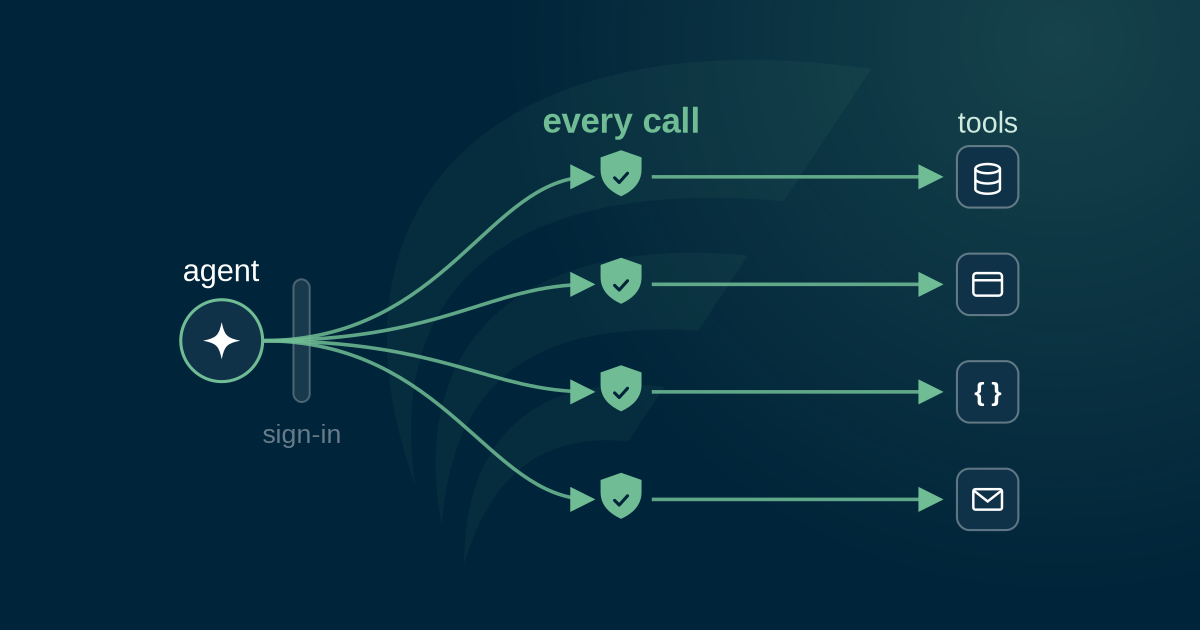
Cloudflare made it the main theme of Connect 2026. This article covers the agents that arrive at your site. For the agents your own teams run, see our Cloudflare One page and our article on Zero Trust for AI agents.
Against Cloudflare's documentation and blog. Several features below are in beta: we update this article when they change.
How much of your traffic comes from AI agents?
Cloudflare reported in September 2026 that, for the first time, more than half of Internet traffic wasn't human, and that daily requests from AI agents on its network had grown by more than 1,700% in a year (Cloudflare blog, 30 September 2026). At Connect 2026, it added that fewer than 1 in 10 automated requests come from a bot that identifies itself. In another post, Cloudflare measured that fewer than half of HTML page requests now come from a human (Cloudflare blog).
The other figures given on stage:
- more than 600 billion requests made by AI agents on its network last quarter;
- human traffic has grown by more than half since early 2025, while automated traffic has doubled;
- Matthew Prince, Cloudflare's CEO, now expects agents to overtake humans in the first half of 2027, rather than the second half he forecast a year earlier;
- extrapolated over five years, agent traffic would reach 1,000 times human traffic.
Source: Cloudflare, Connect 2026 opening keynote, 20 October 2026. Figures as stated on stage.
Keep the two kinds of figure apart. "More than half of traffic is not human" covers every kind of bot. "Agents overtake humans in 2027" covers agents alone, and is a forecast. For a security team, the figure that matters most is the one about identification: most automation does not say who it is.
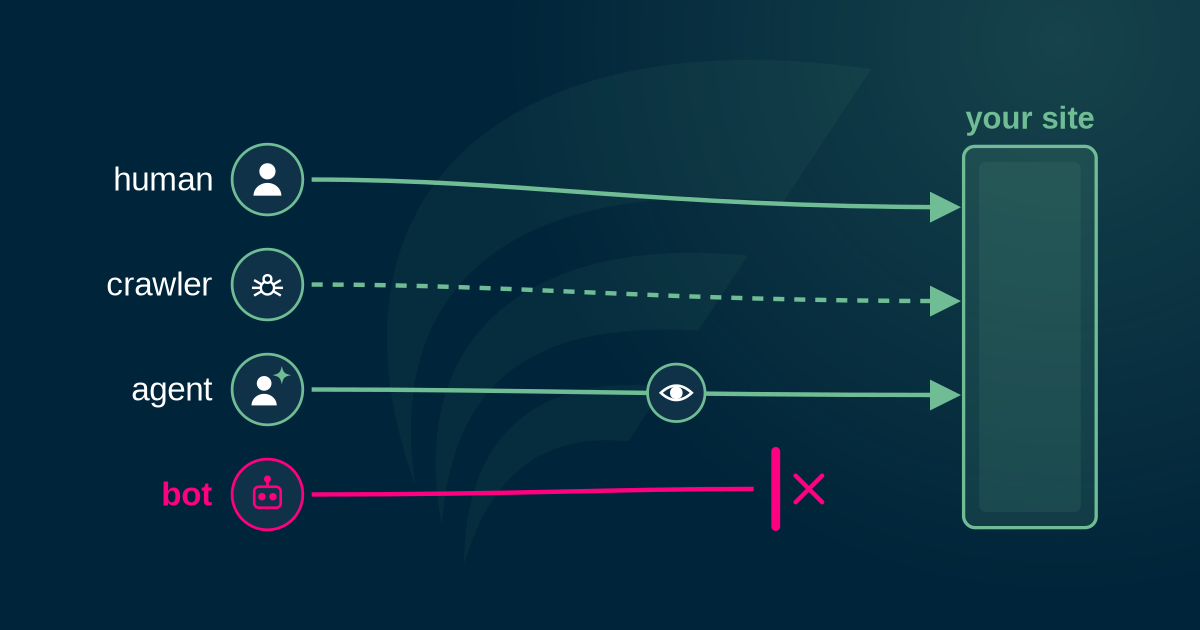
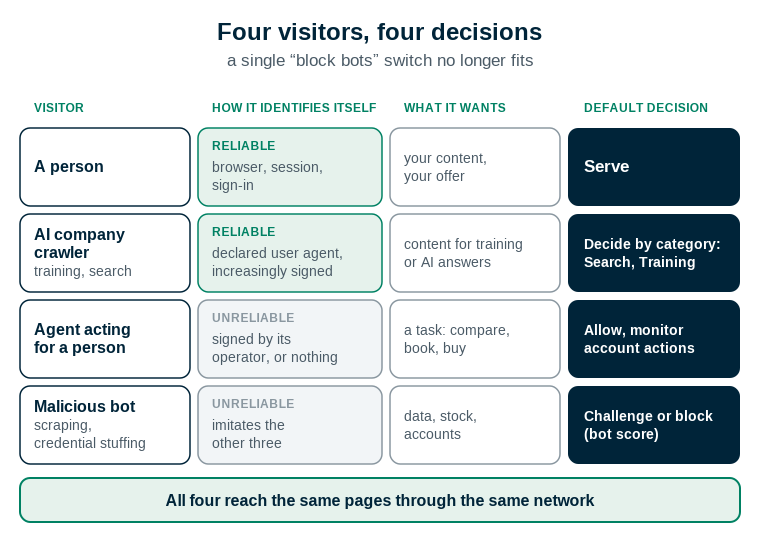
In practice, four kinds of visitor now reach the same pages:
| Visitor | What it wants | How it usually presents itself |
|---|---|---|
| A person | your content, your offer | a browser, a session, a sign-in |
| An AI company's crawler | content for training or for search answers | a declared user agent, increasingly a cryptographic signature |
| An agent acting for a person | to complete a task: compare, book, buy | a request signed by the agent's operator, or nothing |
| A malicious bot | data, stock, accounts | it imitates one of the three above |
Why does agent traffic cost more than it brings?
Because the work and the revenue no longer arrive together. According to Cloudflare at Connect 2026, an agent shopping for a customer visits hundreds of stores and buys from one; the others bear the cost of the visit. Cloudflare also said on stage that AI crawlers now explore more than Google's search crawler, sometimes reading thousands of pages for every visitor they send back. You can check the ratio for each platform on Cloudflare Radar, which publishes a crawl-to-refer ratio: the number of HTML pages a platform crawls for each visit it refers back to a site.
Matthew Prince summed up the risk with what he calls the deli problem. A person picks the local shop out of loyalty; an agent picks what it knows best, which favours the largest players. For a mid-sized company, that leaves two bad options. Block everything and you disappear from the answers your customers read. Let everything in and you pay for traffic that does not convert.
How do you tell a legitimate agent from a scraper?
Three mechanisms, from the most reliable to the broadest, all available today.
A signature. With Web Bot Auth, a bot or agent signs its HTTP requests with a private key, and the site checks them against the public keys published by the operator. Unlike a user agent, a signature cannot be copied. OpenAI's ChatGPT agent was among the first signed agents, in 2025 (Cloudflare blog). The browser in AWS Bedrock AgentCore signs its requests too, in preview (AWS documentation).
A directory and a reputation. Since 1 July 2026, signed agents are listed among Cloudflare's verified bots, with a field that separates direct access (a crawler acting for its operator) from intermediary access (an agent acting for a person). On 16 October 2026, Cloudflare announced a trust band based on whether a bot respects robots.txt and requests to slow down, to be published on Radar (Cloudflare blog). And since 4 November 2026, a Personal Assistants category in Security Analytics shows which agents visit, on which paths, and whether they reach checkout (Cloudflare blog).
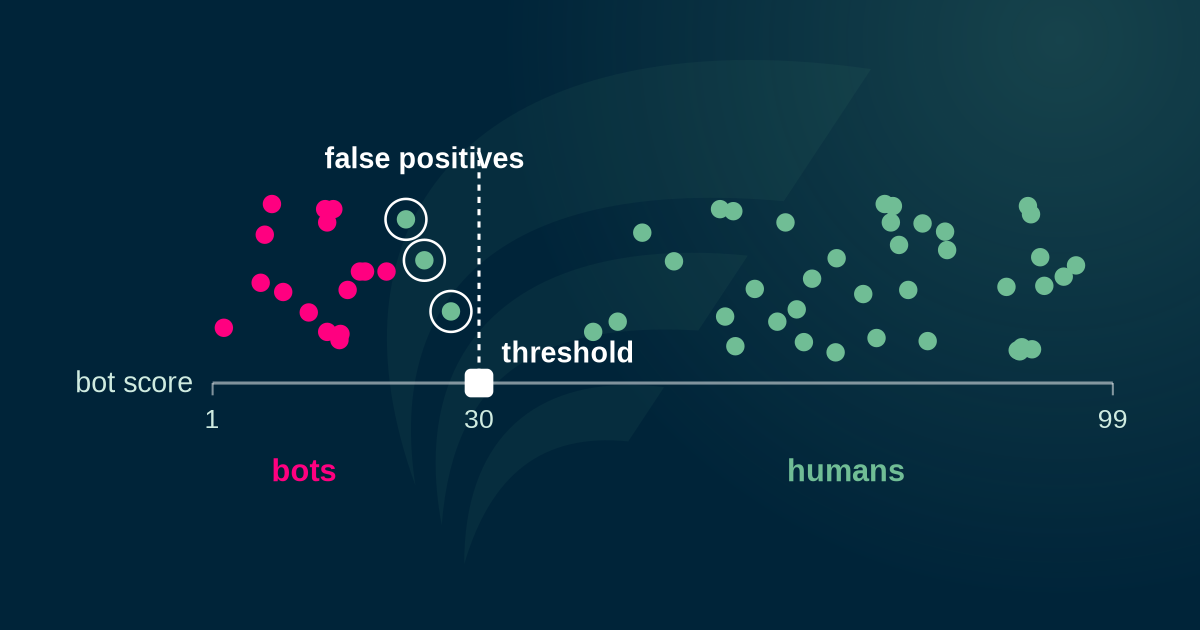
A score for everything else. Requests that do not identify themselves, by far the largest group, receive a bot score from 1 to 99, computed by supervised machine learning and backed by detection rules. This is the layer that stops credential stuffing (testing stolen passwords at scale) and scraping. Our Cloudflare Bot Management production guide covers how to tune it, and our glossary explains bot mitigation.
What does not exist yet: an agent that proves something about the person it represents, without revealing who they are. It was presented on stage as coming soon. Cloudflare's blog describes it as ongoing work based on anonymous credentials being standardised at the IETF (Internet Engineering Task Force). Do not build a payment journey on it yet.
Which rules should you set for each kind of agent?
Cloudflare's AI crawler and agent access policies sort AI traffic into three categories: Search, Agent and Training. Each can be allowed, blocked, or blocked only on pages that carry ads; Training can also be disallowed in robots.txt. Agents acting for a person have their own Personal Agent policies, which inherit the Agent policy by default.
Defaults have moved during 2026. The changelog announced that from 15 September 2026, new domains would block Training and Agent on pages with ads and allow Search; the documentation, updated in November, shows Allow for all three on new domains. Rather than relying on a default, check what your own zones actually apply.
| Visitor | Reasonable default | Cloudflare control | Status |
|---|---|---|---|
| AI platform's search crawler | allow, if you want to appear in AI answers | Search policy | available |
| Training crawler | your call: state it in robots.txt and enforce it | Training policy, Content Signals | available |
| A customer's personal assistant | allow on content and checkout, monitor actions on the account | per-agent policies, Personal Assistants view | available since 4 Nov 2026 |
| Unidentified automation | challenge or block on sign-in, checkout and APIs | bot score, custom rules | available |
| A bot that ignores your preferences | block | per-crawler rules and robots.txt tracking in AI Crawl Control | available, all plans |
Content Signals state your preference in robots.txt (search, ai-input, ai-train). They are a statement, not a block: enforcement goes through the policies above.
An agent that reaches your checkout is a customer with a different user agent.
Before you block the Agent category, look at a week of Personal Assistants traffic: which paths, which status codes, how many reach the payment step. If agents fail on your checkout, that's a conversion problem, not a security one.
Agent traffic hits APIs (application programming interfaces) as much as pages, so it belongs in the same policy as your WAF and API protection: see web application and API protection and our application security practice. Implementation is detailed in AI agent traffic management.
Request an AI agent traffic review →
Can you charge AI crawlers and agents?
Yes, in beta. Matthew Prince put the approach in one line at the keynote on 20 October 2026: "We cut the load and price what's left."
Cloudflare offers three ways to charge AI crawlers and agents, none generally available yet: Pay Per Crawl (closed beta), which answers unpaid crawlers with HTTP 402 (Payment Required); Pay Per Use (beta since 30 September 2026), which pays when content is used; and Monetization Gateway (closed beta), which prices any request, including a call to an MCP tool. MCP, the Model Context Protocol, is the standard that connects an agent to tools and data.
| Mechanism | What it does | Status |
|---|---|---|
| Pay Per Crawl | a crawler that does not pay receives HTTP 402 with a crawler-price header; a crawler that pays gets the page | closed beta |
| Pay Per Use | an AI company offers a price for a given use of the content; the publisher accepts or declines, Cloudflare bills and pays out | beta since 30 Sep 2026 |
| Monetization Gateway | a price on any request, including a call to an MCP tool, settled with x402 | closed beta, US buyers and sellers only |
Underneath sits x402, an open payment standard built on HTTP 402. Cloudflare and Coinbase announced the x402 Foundation in September 2025, and x402 is supported in Cloudflare's Agents SDK, including for paid MCP tool calls.
On stage, Mastercard showed an agent running on AWS AgentCore, given a proposed budget of $3.50, paying each supplier in the currency that supplier preferred; Cloudflare AI Gateway was one of them (according to Cloudflare, Connect 2026). Mastercard launched Agent Pay in April 2025, and it relies on Web Bot Auth to recognise agents (Cloudflare blog).
Cutting the load is the other half. Crawler Hints, available on all plans, tells search engines through IndexNow when a page has likely changed. Cloudflare also ran a research pilot with OpenAI on around 1% of its network, which surfaced hundreds of millions of new pages (Cloudflare blog). It is a pilot, not a setting.
Who is concerned? Publishers, data providers and companies that sell API access have a revenue question. Everyone else has a cost question. In both cases, keep the beta features away from critical journeys.
How do you stay visible to the agents your customers use?
Blocking is only half the subject. If your customers ask an assistant where to buy, you want to be in the answer.
Agent Readiness, a report available in Cloudflare's URL Scanner and on Radar, checks what an agent needs to read and use your site: robots.txt, sitemap, Markdown versions of pages, Content Signals, MCP, Web Bot Auth and x402. AEO Visibility, where AEO stands for answer engine optimisation, shows how AI assistants answer your customers' questions and which sources carry weight. It is in early access.
According to Cloudflare at Connect 2026, Shopify is turning on the Universal Commerce Protocol (UCP) by default for all its merchants: the agent buys, and the merchant's journey and rules still apply. UCP is an open commerce standard backed by Google and Shopify, among others. What this means for a store is covered on our retail page.
What should you do this quarter?
- Measure. Open the Personal Assistants view and AI Crawl Control: who visits, how often, on which paths.
- Classify your paths: public content, account, checkout, API. The rule for an agent isn't the same on a product page and on a password reset.
- Write the policies by category, then by agent, in log mode first. Block once a week of logs confirms that no customer is being stopped.
- Protect sign-in, checkout and APIs against unidentified automation (bot score, rate limiting), whatever you decide for verified agents.
- Decide whether you sell content or data. If so, test Pay Per Use or Monetization Gateway on a narrow scope; if not, focus on reducing crawl load.
- Review every month. Defaults, categories and beta features changed several times in 2026.
Keep beta features (Pay Per Crawl, Monetization Gateway) out of the path of a paying customer, and document a fallback for each. Their behaviour can still change before general availability.
The same logic of programmable rules applies to traffic leaving your network, with Gateway Forward.
At Brixio, our engineers deploy and operate these controls on Cloudflare, with 450+ projects delivered and 24/7 operations from Paris, Dubai, Singapore, Casablanca and Zurich, through professional services and managed services. When the need goes beyond standard policies, we build on Workers, as with Bot Shield, built entirely on Workers for an airline.
The agentic internet: frequently asked questions
It is a web where AI agents read, compare, buy and call services on behalf of people and companies. For a website, it means a second audience alongside humans, with its own rules: some agents bring customers, others only consume resources.
Cloudflare reported in September 2026 that, for the first time, more than half of Internet traffic wasn't human, and that daily AI agent requests had grown by more than 1,700% in a year. At Connect 2026, it put agent requests on its network at more than 600 billion in the last quarter.
Web Bot Auth lets a bot or agent sign its HTTP requests with a private key, so the site can check them against the operator's published public keys. Cloudflare uses it in its Verified Bots programme, and ChatGPT agent signs its requests this way.
Not all of them. Search crawlers decide whether you appear in AI answers, and personal assistants may be acting for your customers. Decide by category (Search, Agent, Training) and by path, start in log mode, and keep strict protection on sign-in, checkout and APIs against unidentified automation.
Pay Per Crawl is in closed beta. Pay Per Use has been in beta since 30 September 2026, and pays when content is used rather than when it is crawled. Monetization Gateway, which prices any request, is in closed beta for US buyers and sellers.
x402 is an open payment standard built on the HTTP 402 Payment Required status code: the server states a price, the client pays and retries the request. Cloudflare and Coinbase announced the x402 Foundation in September 2025, and Cloudflare's Agents SDK supports it, including for paid MCP tool calls.