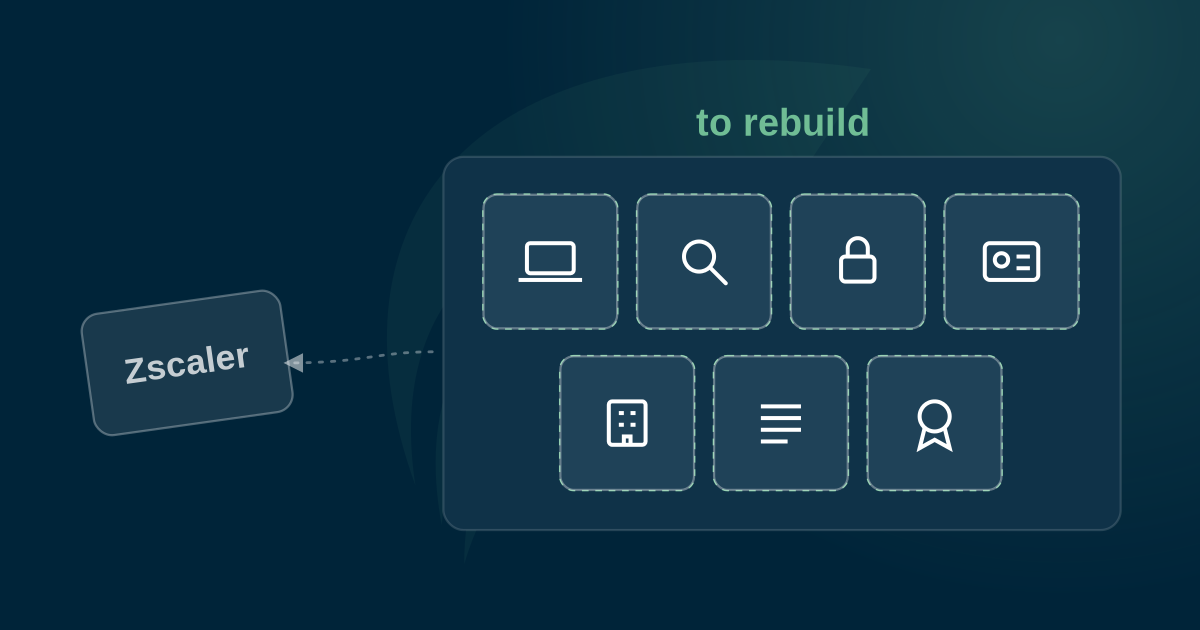
A Zscaler estate that has run for a few years holds more than policies: custom URL categories, SSL inspection exceptions, App Connectors in every data centre, bypass lists nobody remembers writing. When the renewal comes up and Cloudflare One is on the table, the question isn't whether the features exist on the other side. It's what has to be taken apart, rebuilt and decided, and in what order, without cutting anyone off.
Cloudflare publishes tooling that automates a large share of the mapping, and came back to it at Connect 2026. The rest is decisions, and this article is about those. It doesn't help you choose between vendors; our guide to Zscaler alternatives does. It assumes you've chosen Cloudflare One, described on our Cloudflare One page, and want to know what a Zscaler to Cloudflare One migration involves.
Why is a Zscaler migration a policy project before a connectivity project?
In a Zscaler replacement project, the transport is the easy part. The agent on laptops, the tunnels from sites and the connectors in front of private applications can all be replaced in stages. What takes time is the rules, the objects they reference and the exceptions that piled up around them.
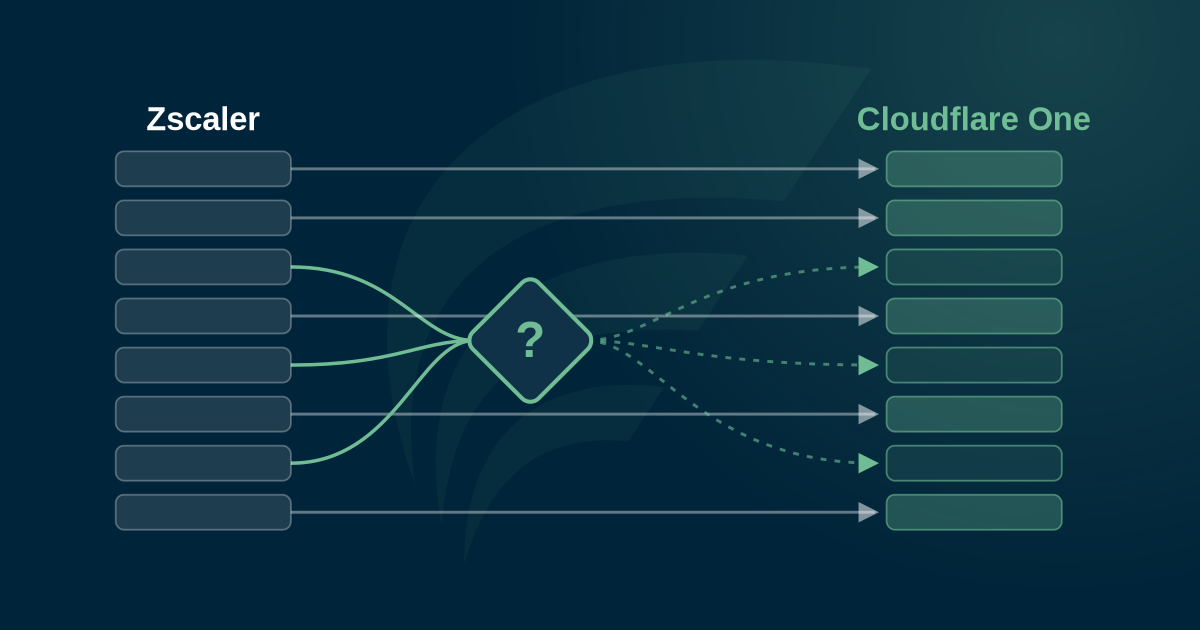
A migration from Zscaler to Cloudflare One is a policy project before it is a connectivity project. Cloudflare publishes an agent skill, cloudflare-one-migrations, that maps Zscaler ZIA and ZPA objects to Gateway, Access and Cloudflare Tunnel; according to Cloudflare at Connect 2026, its migration tooling covers about 80% of the configuration. The rest is decisions: exceptions, behaviours with no exact equivalent, and acceptance testing.
The skill sits in Cloudflare's public skills repository. It guides an AI agent through assessing and planning a move to Cloudflare One from Zscaler Internet Access (ZIA), Zscaler Private Access (ZPA), Palo Alto Networks, and legacy VPN, secure web gateway (SWG) and software-defined WAN (SD-WAN) estates.
It sets one principle worth keeping whatever tool you use: every source rule maps either to a Cloudflare object or to an explicit "Not Migrated" row with a reason and its security impact. Nothing disappears quietly.
A migration is finished when every source rule has an owner, not when the last tunnel is up.
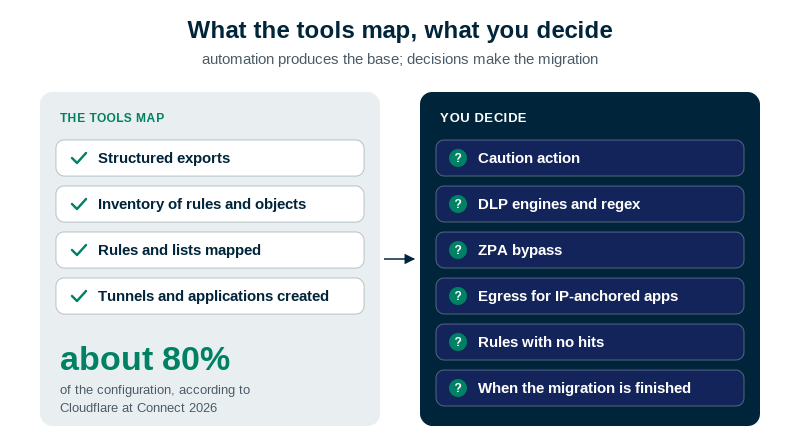
If you'd rather have engineers who have done this run the mapping with you, that is what our professional services team does.
Which Zscaler components map to which Cloudflare One components?
Both are documented as security service edge (SSE) platforms within a wider secure access service edge (SASE). The table pairs each component as each vendor documents it.
| Zscaler | Role | Cloudflare One | What the migration involves |
|---|---|---|---|
| Zscaler Internet Access (ZIA), listed as "Internet & SaaS" in Zscaler's documentation | filtering Internet and SaaS traffic | Cloudflare Gateway (DNS, network, HTTP) | reorganise rules and lists (one custom category can become several lists) |
| Zscaler Private Access (ZPA) | access to company applications from outside the network | Cloudflare Access with Cloudflare Tunnel | create applications, routes, DNS and policies as separate objects |
| Application segment, server group | grouping of applications and of the servers that host them | Access application, CIDR and hostname routes on the tunnel | split each segment between applications and routes; there is no one-to-one match |
| App Connector, connector group | connectors deployed in groups for high availability | one Cloudflare Tunnel per group, one cloudflared replica per connector | plan connector installation and authentication |
| Zscaler Client Connector | agent on users' devices that forwards traffic to the Zscaler service | Cloudflare One Client (formerly WARP) | configure device profiles, Split Tunnels and posture checks |
| GRE or IPsec tunnels, locations | connecting sites | Cloudflare WAN, Cloudflare Mesh; location IPs as source IP lists | run site connectivity as a separate workstream |
| SSL/TLS inspection | decryption and inspection, with a Zscaler intermediate certificate or the organisation's own root | Gateway TLS inspection, Do Not Inspect exemptions | deploy the root certificate chosen for Gateway, revalidate the exemption list |
| Data loss prevention (DLP) policy | protection against data loss | Cloudflare DLP | recreate profiles and expressions, test before enabling |
Sources: Zscaler Help (application segments, server groups, App Connector groups, Client Connector, GRE tunnels, locations, SSL/TLS inspection, DLP); Cloudflare documentation and the migration skill.
Three remarks. The names line up; the way objects are cut does not. Cloudflare keeps Access applications, tunnel routes, DNS and policies as separate objects, so, as the skill puts it, "ZPA app segments, server groups, and connector groups do not map 1:1". Site transport, the GRE or IPsec tunnels to ZIA, is its own project, towards Cloudflare WAN (formerly Magic WAN) or Cloudflare Mesh (formerly WARP Connector). And the device client changes: Cloudflare One Client encrypts traffic to Cloudflare with MASQUE or WireGuard. For the vocabulary on each side, see secure web gateway and ZTNA in our glossary.
What should you export from Zscaler before mapping anything?
Structured exports, not screenshots or summaries. A screenshot hides the objects a rule references, and a mapping built on it silently drops them.
From ZIA, the skill lists: URL filtering, firewall filtering, SSL inspection, DLP, custom URL categories, IP groups, network services and service groups, users, groups and departments, locations, GRE tunnels and static IPs.
From ZPA: application segments, segment groups, server groups, App Connectors and connector groups, access policies, identity provider (IdP) and group mapping, private DNS domains, ports and protocols.
Ask for the hit counts too. They separate disabled rules, rules nobody has matched, heavily used rules and the critical exceptions. Deleting a rule with no hits is still a decision for its owner, not for the tool.
Identity comes first. SCIM (System for Cross-domain Identity Management), which synchronises users and groups from your IdP, is the prerequisite for group selectors in Cloudflare (SCIM documentation). Without it, a ZIA rule scoped to a group becomes a rule that applies too widely, unless you replace the group with an enforceable list of users.
Ask for the hit counts with the exports. A rule nobody has matched in a year is a decision for its owner, not something to migrate by default.
How do ZIA policies carry over to Cloudflare Gateway?
ZIA and secure web gateway rules usually map to Gateway traffic policies and Gateway lists. Most of the work is in the details below.
| ZIA object | Cloudflare match | Level | What to check |
|---|---|---|---|
| URL filtering rule | Gateway HTTP or DNS policy | direct | rule order, identity selectors, hit counts carried over |
| Custom URL category | several Gateway lists (IP, domain, URL) | partial | count the lists produced, not the source categories |
| Location with IPs | source IP list | partial | not an automatic Gateway DNS location |
| GRE tunnel | source IP in policy conditions; transport via Cloudflare WAN or Mesh | partial | transport handled as its own workstream |
| Caution action | none exact | decision | allow, block, or build an intermediate page |
| DLP engine, custom regex | Cloudflare DLP profile, rebuilt by hand | decision | no replacement rule enabled before the profile is complete |
| Network application group, unsupported protocol | partial match | decision | reviewed before enabling |
| SSL inspection rule | Gateway TLS inspection, Do Not Inspect | partial | test before broad HTTP and DLP blocks |
The Caution action deserves a paragraph. In ZIA, Caution displays an end user notification that "cautions users before allowing them access to the site" (Zscaler, URL filtering policy). Gateway has no exact equivalent, and Cloudflare's skill says to treat it as an explicit decision rather than a silent allow or block. One option is to build an intermediate page with Gateway Forward, in public beta since 15 October 2026: Cloudflare's coaching page template displays a notice with a link to an approved alternative. It is a different behaviour, not the same one: the template, as documented, does not unlock the original site once the user has read the notice. Our article on Gateway Forward covers the mechanism.
DLP needs the most patience. Engines and custom regular expressions have to be rebuilt by hand in Cloudflare DLP profiles, and a placeholder rule must not be switched on as if the profile were complete. If your data loss prevention is run as a service, see our DLP service.
TLS inspection comes before blocking. Test inspection and the Do Not Inspect exemptions with a pilot group before enabling HTTP and DLP blocks widely. Applications that pin their certificate stay exempt.
How do ZPA applications move to Access and Cloudflare Tunnel?
Private access is where the skill is most precise, and where the topology has to be preserved.
Create one Cloudflare Tunnel per ZPA connector group, whatever the group's current status. Each connector instance in the group becomes a cloudflared replica on that tunnel; the skill recommends replicas in the same data centre but on different hosts or subnets. Creating the tunnel through the API does not deploy anything: installation, authentication and reachability of the origin are separate tasks to plan.
The IP addresses and ranges in each application segment become CIDR routes (Classless Inter-Domain Routing, address ranges) on the matching tunnel, and domain names become hostname routes. Where one subnet covers all the segment's addresses, prefer one route for the subnet over a /32 route per host.
A ZPA bypass is not an Access decision. It becomes a Split Tunnels exclusion in the Cloudflare One Client device profile, added in the dashboard: the skill notes there is no API automation for this step.
Each ZPA access policy rule becomes a reusable Access policy. Create them all before attaching them to applications.
Two limits need to be dealt with before you start. By default an Access application holds 5 hostnames; your Cloudflare account team can raise it to 50, and the increase has to be active before you create the applications. And applications that trust a source IP need an egress decision: keep the source IP through your own egress, use Cloudflare's dedicated egress where available, or update the target's allowlist. The skill calls this a decision that blocks implementation if left open.
If you migrate ZIA and ZPA together, one rule protects the private applications. In a default-deny Gateway network policy set, add a network allow rule with the selector "Self-hosted Access App with Private Address is Present" and place it above the block rules carried over from ZIA. Without it, Gateway blocks private application traffic before Access evaluates its policy.
For the VPN side of the project, Cloudflare's VPN migration design guide and Replace your VPN describe the patterns, and our ZTNA solutions page covers the service.
Request the higher hostname limit for Access applications from your Cloudflare account team before you create the first application. Without it, large ZPA segments split into several applications with identical policies.
What replaces Zscaler Client Connector on users' devices?
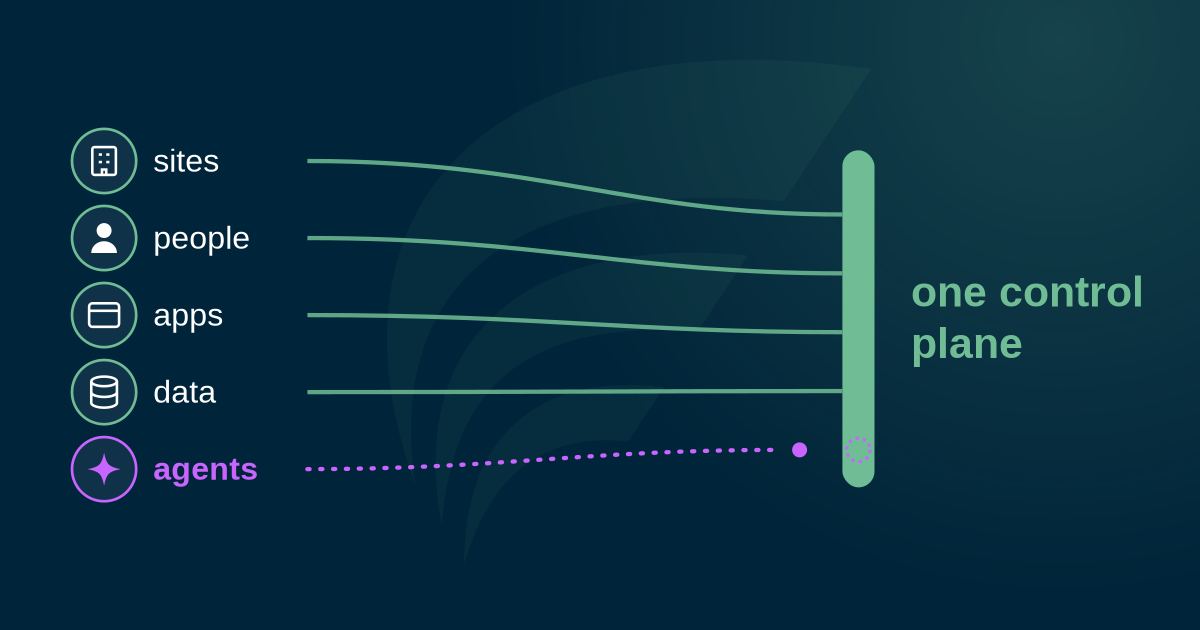
Cloudflare One Client, formerly WARP. It encrypts the device's traffic to Cloudflare, with MASQUE (using post-quantum key agreement) or WireGuard, and carries Gateway policies, device posture and access to the private network.
Four things to prepare before the first device moves:
- the root certificate used for HTTPS inspection, deployed to managed devices;
- the Do Not Inspect list;
- device profiles and Split Tunnels, including the exclusions inherited from ZPA bypass rules;
- posture checks, rebuilt from your existing endpoint detection and response (EDR) integrations.
Roll out by pilot group: the devices in one group switch client while everyone else stays on Zscaler. Whether both clients can run side by side on the same device is not documented in the sources we reviewed, so test it on your own build before planning around it. For the background on VPN replacement and Zero Trust, see our glossary.
In what order do you cut over, and how long do both platforms run side by side?
Dependencies first. The skill's order is:
- identity and SCIM;
- connectors and on-ramps (Tunnel, Mesh or Cloudflare WAN);
- routes and private DNS;
- lists and objects;
- TLS exemptions;
- Access applications and policies;
- Gateway policies;
- DLP and cloud access security broker (CASB) policies;
- logging to your security information and event management (SIEM) system.
Prepare without risk. Give every migrated object a prefix, create rules disabled or in audit mode, start with a pilot group or a pilot site, compare Zscaler and Cloudflare logs for the same traffic, then widen.
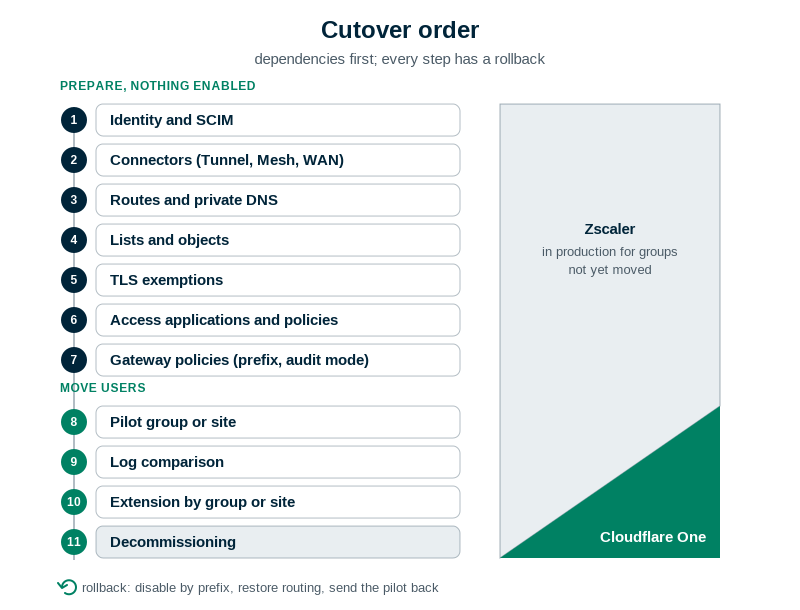
Zscaler stays in production for everything that hasn't moved. How long both run side by side depends on the number of rules, applications and sites, and is set after the assessment, not before.
Write the rollback before the first cutover. Migrated rules can be disabled by their prefix, source routing restored, or the pilot group sent back. Write the decommissioning criteria at the same time, so that switching Zscaler off is a checklist, not a debate.
A first deployment of Cloudflare One follows a different order, since there is nothing to take apart; our Cloudflare One page covers it. For the architecture behind both, see our SASE and Zero Trust practice and Cloudflare's SASE reference architecture.
Plan your Zscaler migration with an engineer →
What doesn't carry over automatically?
| Point | Why | Decision to make | Who |
|---|---|---|---|
| Caution action | no exact equivalent in Gateway | allow, block, or build an intermediate page | CISO |
| DLP engines and regex | rebuilt by hand | DLP profiles rebuilt, tested before enabling | CISO, data owners |
| ZPA bypass | becomes a manual Split Tunnels exclusion | list reviewed and justified | network team |
| IP-anchored applications | the source IP changes | keep the IP, dedicated egress, or update the target's allowlist | application owner |
| Large application segments | 5 hostnames per Access application by default | request the increase (up to 50) before creation, or split | project team |
| Rules with no hits | the tool doesn't decide their fate | delete or keep, with the owner's approval | CISO |
| Groups without SCIM | rules apply too widely | SCIM first, or user lists | identity team |
| Palo Alto rules (App-ID, HIP, zones) | rarely an exact translation | partial mapping flagged, posture rebuilt | architect |
If you are coming from Palo Alto Networks rather than Zscaler, the same skill applies, with its own caveats: expect one rule to produce several Cloudflare resources. App-ID, URL categories, zones, Host Information Profile (HIP) checks, schedules and decryption rarely translate exactly, and HIP checks become device posture checks.
The published skill doesn't cover Netskope yet. According to Cloudflare at Connect 2026, its migration tools cover Netskope too, but that isn't in the public repository at the time of writing: plan a manual mapping.
Some limits belong to the platform rather than to the migration, such as industrial networks, offline sites or pinned certificates. Our Cloudflare One page lists them.
How do you know the migration is finished?
The skill sets validation gates, and they make a good acceptance checklist:
- after each stage, compare the number of Cloudflare objects with the number of source objects, and stop on any mismatch;
- review every item marked unsupported, partial, unmapped, needs identity, needs posture or manual review before enabling policies;
- validate group membership with real pilot users after SCIM synchronisation;
- test TLS inspection before enabling blocks.
The deliverable at the end is the rule accounting table: for each source rule, the migrated object or the partial mapping, the reason it wasn't migrated, its security impact, and the owner of each manual action.
A Zscaler migration is finished when every source rule maps either to a Cloudflare One object or to an explicit "not migrated" row with its reason, its security impact and an owner, and when object counts on both sides match after each stage.
Our engineers test the migration tools on your environment and handle the rest: exceptions, rules specific to your organisation, acceptance testing. Then they run the platform with you. Brixio has delivered 450+ projects, holds ISO/IEC 27001:2022 certification and runs 24/7 operations from Paris, Dubai, Singapore, Casablanca and Zurich. For a SASE deployment in production on Cloudflare, see our UAE driver education group case study.
Plan your Zscaler to Cloudflare One migration →
Not ready to plan yet? Start with an assessment of your current estate. After cutover, our managed services take over operations.
Zscaler to Cloudflare One migration: frequently asked questions
Partly. Cloudflare publishes a migration skill that maps ZIA and ZPA objects to Gateway, Access and Cloudflare Tunnel, and according to Cloudflare at Connect 2026 its tooling covers about 80% of the configuration. The rest is decisions: exceptions, behaviours with no exact equivalent such as the Caution action, and acceptance testing.
Not one to one. The applications in a segment become Access applications, their IP ranges become CIDR routes and their domains hostname routes on the Cloudflare Tunnel that replaces the segment's connector group. Each ZPA access policy rule becomes a reusable Access policy; large segments may need the higher hostname limit per Access application, requested before creation.
Cloudflare Gateway has no exact equivalent of the Zscaler Caution action, which displays a notification that cautions users before allowing them access to a site. Cloudflare's migration guidance treats it as an explicit decision, not a silent allow or block. The options are to allow, to block, or to build an intermediate page, for instance with the Gateway Forward coaching page template, in public beta.
Yes, by group or by site: the groups that have moved use Cloudflare One, the others stay on Zscaler until the decommissioning criteria are met. Running both clients on the same device is not documented, so test it before relying on it.
Cloudflare One Client, formerly WARP. It encrypts device traffic to Cloudflare with MASQUE or WireGuard and carries Gateway policies, device posture and private network access. Its device profiles and Split Tunnels take over the exclusions inherited from ZPA bypass rules, and it needs a root certificate for HTTPS inspection before rollout.
It depends on the number of rules, applications and sites, and on how many decisions are still open, such as Caution, DLP or IP-anchored applications. A realistic plan is set after an assessment of your exports, not before. Until then, Zscaler stays in production for everything that hasn't moved.
Zscaler, ZIA and ZPA are trademarks of Zscaler, Inc.