Many security teams now send alerts and tickets to a general-purpose large language model (LLM) with a closed question: is this urgent, which team owns it, what is the invoice total. The model writes an answer that someone has to parse, takes seconds to do it, and doesn't always answer the same way twice. In October 2026 Cloudflare released two models built for those closed questions on Workers AI: Clef, which decides, and Clairic, which extracts. Clairic arrived on 19 October, the first day of Connect 2026.
No customer has published results with either model yet. This article sticks to what Cloudflare has published, and to how you can check it on your own data.
Clef and Clef-flash available on Workers AI since 1 October 2026, open weights under Apache 2.0; Clef-omni available since 9 October 2026; Clairic in preview since 19 October 2026, open weights announced. We update this article when the status changes.
What are Clef and Clairic?
Cloudflare Clef and Clairic are models trained by Cloudflare and served on Workers AI that answer in a single pass instead of generating text. Clef is a decision model: it reads a state and a set of typed questions and returns a probability for every allowed answer. Clairic is an extraction model: it returns typed values, such as numbers, dates or lists, read from the input, computed from it or estimated beyond it.
The vocabulary is not Cloudflare's. Typesafe introduced "System One models" with Jev, its own decision model, and borrowed the term from Daniel Kahneman's Thinking, Fast and Slow: System One is fast and precise, System Two is slow and deliberate. Cloudflare places LLMs in System Two and its two new models in System One. The Clairic launch post splits the work in three:
| Task | Model | What comes back |
|---|---|---|
| Extract (System One) | Clairic | typed values, each with a confidence |
| Decide (System One) | Clef | a probability for every allowed answer |
| Write and reason (System Two) | a general-purpose LLM | free text |
Clef and Clef-flash are the first models trained by the Workers AI team itself. The name comes from music: a clef sets how you read the notes that follow, and "CF" nods to Cloudflare. Both now sit in the Workers AI model catalogue, which also covers general-purpose LLMs, embedding models and image models: the models they are meant to work with.
| Model | What it returns | Size and context | Inputs | Status |
|---|---|---|---|---|
| Clef | a probability for each allowed answer, up to 64 questions per call | 27B parameters, 65,536 tokens | text, JSON, images, video | available since 1 Oct 2026, weights under Apache 2.0 |
| Clef-flash | the same, for latency-sensitive decisions | 9B parameters, 24,576 tokens on Workers AI (down from 64K on 9 Oct 2026; up to 256K self-hosted) | text, JSON, images, video | available since 1 Oct 2026, weights under Apache 2.0 |
| Clef-omni | the same, across all modalities | mixture of experts (MoE), 30B parameters with 3B active, 64,000 tokens | text, JSON, images, audio, video | available since 9 Oct 2026 |
| Clairic | one typed value per field, with p_null, confidence and an 80% interval | 65,536 tokens | text, up to four images | preview since 19 Oct 2026, open weights announced |
All four are billed on input tokens only. Since they write nothing, there are no output tokens to pay for.
What has Cloudflare actually measured?
Every figure below comes from Cloudflare. We have copied them as published.
| Result | Model | Dataset or context | Measured by | Source |
|---|---|---|---|---|
| 2.2 s to fetch, render and classify a domain, against 4.7 s for gpt-oss-120b, which returned only two categories | Clef with Browser Run | domain classification, Threat Intelligence team | Cloudflare | Clef launch post |
| median latency 209.3 ms (Clef), 38.8 ms (Clef-flash), 524.1 ms (Jev) | Clef, Clef-flash | 43 benchmark runs | Cloudflare | Clef changelog |
| security incidents: 62.9 (Clef), 61.7 (Clef-flash), 61.7 (Jev) | Clef, Clef-flash | Typesafe's workflow evaluation suite | Cloudflare | Clef launch post |
| highest score on 7 of 10 decision benchmarks | Clef family | BFCL, BANKING77, CLINC150+OOS and others | Cloudflare | Clef changelog |
| about 20 ms (text), under 100 ms (image or audio), about 300 ms (21-second video with sound) | Clef-omni | latency | Cloudflare | Clef-omni changelog |
| forecasts off by 3.3% on average, 17 of 21 days inside the 80% interval | Clairic | daily passengers screened by the US Transportation Security Administration (TSA), 21 days | Cloudflare | Clairic launch post |
No third party has reproduced these numbers so far.
The only production use Cloudflare has published is its own: its Threat Intelligence team classifies website domains with Clef and Browser Run in 2.2 seconds, against 4.7 seconds for gpt-oss-120b in the same workflow, according to Cloudflare. No customer had published results with Clef or Clairic as of November 2026.
Read them as an operator would. These are the vendor's own tests, on its own infrastructure. And Typesafe's suite covers four workflows with small gaps: invoice processing 64.7 for Clef, 57.1 for Clef-flash, 61.8 for Jev; customer service 76.3, 77 and 76.0; agent trace observability 68.5, 69.8 and 71.6, where Jev leads. The line that matters most to a security team is the narrowest: on "security incidents", Clef scores 62.9 against 61.7 for Jev, and Clef-flash ties Jev. About one point.
One more figure deserves a look from a security operations centre (SOC). CLINC150+OOS includes requests that fit none of the listed intents. Clef scores 97.43 there, Jev 89.27, and Clef-flash 66.77. Alerts that fit none of your categories are part of daily life in a SOC, so test that case on purpose.
The latency table is also a launch snapshot. On 9 October, Cloudflare said it had made Clef up to twice as fast. Expect your own measurements to differ from both.
Cloudflare also lists what it wants to fine-tune Clef for internally: reviewing Trust & Safety submissions, triaging Cloudflare Support requests, telling good bots from bad ones. Those are intentions. Cloudflare has published no results for them.
Clairic's TSA forecast, and its lesson. Cloudflare asked Clairic each morning for the next day's TSA checkpoint count, for 21 days. The forecasts were off by 3.3% on average and 17 of the 21 real counts landed inside the 80% interval. Three of the four misses fell on the Columbus Day weekend, when more people flew than the previous weeks suggested. The model reads patterns in the series. It does not know about events the series doesn't contain.
A benchmark tells you the model can decide. Only your own history tells you it decides like your analysts.
How would Clef triage a security alert?
Nothing here has been published by Cloudflare for security alerts. It is our transposition of the "support triage" and "agent guardrails" examples in the Clef changelog, and it is what we would test first.
You turn the alert into typed questions, the way an analyst would ask them. Clef accepts three types, up to 64 questions per call:
noul, a yes or no question: "Does this alert need the on-call analyst now?" Clef returns the probability of yes.choice, one option from a set you define: "Which queue owns it: network, identity, application, or false positive?" Clef returns the chosen option, a probability per option and a confidence value.score, a level on an ordered rubric: severity from "no impact" to "critical". Clef returns a probability-weighted score and a probability per level.
Here is what that looks like on Workers, adapted from Cloudflare's example. It is illustrative, not a finished integration.
const triage = await env.AI.run("@cf/cloudflare/clef-flash", {
  model: "clef-flash",
  state: alertText, // the alert as your SIEM exports it
  questions: {
    page_on_call: {
      type: "noul",
      instructions: "Does this alert need the on-call analyst now?",
    },
    queue: {
      type: "choice",
      instructions: "Which queue should handle this alert?",
      criteria: {
        network: "Firewall, DDoS, unusual traffic",
        identity: "Logins, MFA, privilege changes",
        application: "WAF events, API abuse, application errors",
        false_positive: "Known benign activity",
      },
    },
    severity: {
      type: "score",
      instructions: "How severe is the impact on the business?",
      criteria: ["No impact", "Minor", "Major", "Critical"],
    },
  },
});
// triage.answers.queue -> chosen queue with a probability per option
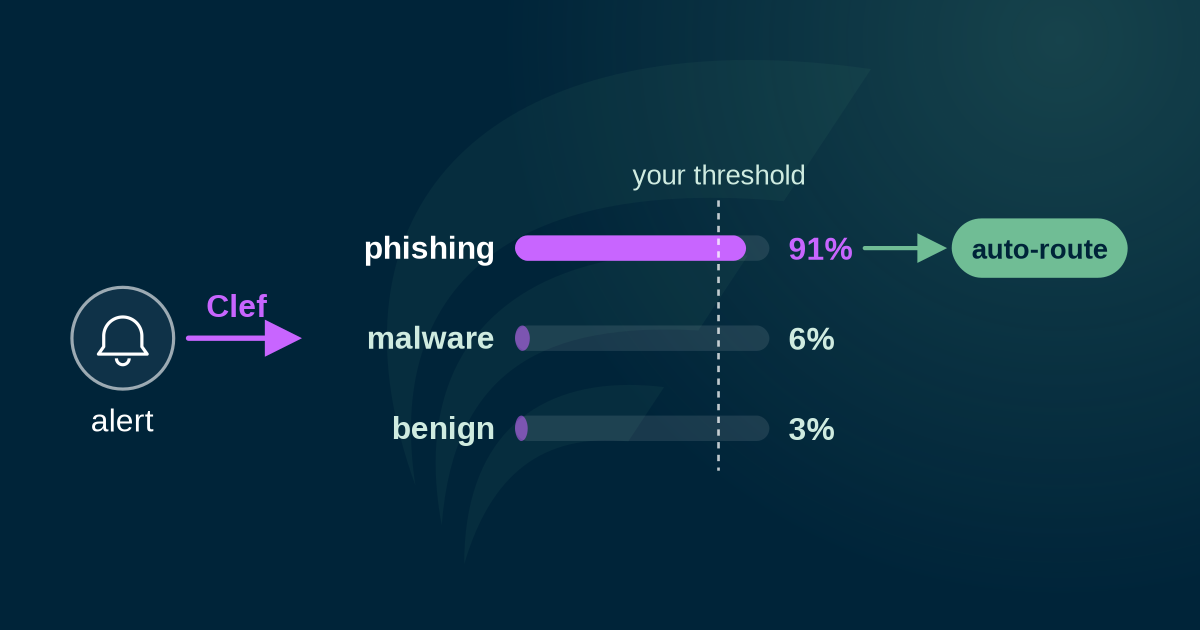
Because every answer carries a probability, you can set thresholds instead of trusting a sentence. Above a high threshold, the alert is routed automatically. Between two thresholds, it goes to an analyst's queue. Below a low one, closing it is proposed, not done: a human confirms. That is what alert triage in a managed SOC looks like with a decision model in it: the model sorts, the thresholds decide who looks.
The same mechanism covers agent guardrails. Cloudflare documents the pattern where an agent asks Clef "should I take this action?" in tens of milliseconds before it calls a tool. Screenshots and video already work with Clef. If an alert comes with a voice recording, Clef-omni reads it in the same request.
Start with Clef-flash. It answers in tens of milliseconds, so you can replay months of alerts quickly; move to Clef only for the questions where its accuracy matters more than latency.
How would Clairic pull fields from tickets, e-mails and invoices?
Clairic does for open values what Clef does for choices. You send the text and a schema of typed fields, and it returns one value per field: an exact span of the text with its character offsets, a number, a date or time, a duration, a list, an estimate within your bounds, or a forecast of up to 64 steps. Each scalar answer has a p_null, the probability that the input doesn't contain the value, and a confidence score. Estimates and forecasts come with a median and an 80% interval. You can add up to four images.
The character offsets matter more than they look. When an auditor asks where a value came from, you can point to the exact passage in the source.
Cloudflare's examples are an invoice, a receipt and a customer e-mail about a damaged product. For a security team, we would test ticket identifiers, timestamps, and lists of IP addresses or domains in a phishing report sent by an employee. Cloudflare has published nothing on those cases yet.
Clairic has been in preview on Workers AI since 19 October 2026. Cloudflare describes one- and two-step calculations as reliable, but not long chains of dependent steps, and says forecasts several steps out flatten towards the average. Every answer is well formed, not necessarily correct: confidence, p_null and intervals decide what to automate.
The Clairic changelog is unusually frank about what this "early checkpoint" does not do well yet:
| Point | What Cloudflare says | What to plan for |
|---|---|---|
| Calculations | one or two steps are reliable; long chains and aggregations across many rows are not | extract with Clairic, calculate in code |
| Estimates | good with comparables or history; wide interval without them | give it the history or comparables |
| Forecasts | basic; several steps out they flatten towards the average; events missing from the series are ignored | not a replacement for a time series model |
| Calibration | calibrated on most held-out sets, can run narrow on unfamiliar data | validate on your own data |
| Confidence | every answer is well formed, not necessarily correct | thresholds on confidence, p_null and intervals |
| Dates | a missing year is inferred from context | set reference_date |
How do Clairic, Clef and an LLM work together?
Cloudflare describes a sequence: an extraction model predicts values, a decision model decides what to do with them, an LLM acts. Its example is the damaged-product e-mail. Clairic pulls out the customer's name, the order number, the amount paid, the days since delivery, the list of damage and an estimated repair cost. Clef then picks between refund and other options from those values and the policy, never from the raw e-mail. An LLM writes the reply.
Transposed to a SOC, the flow would look like this:
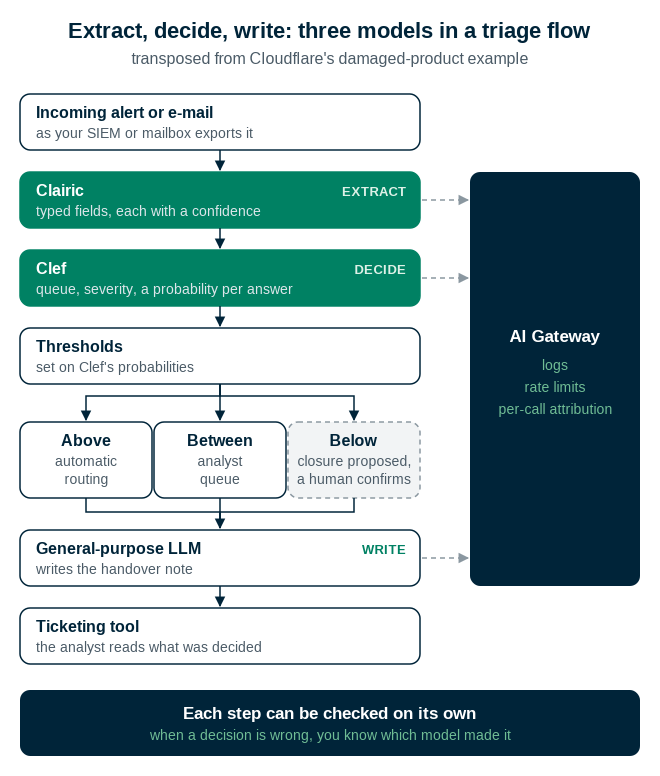
Each step can be checked on its own. You can measure whether Clairic got the fields right before you ask whether Clef chose the right queue, and the LLM only writes text an analyst will read. When an automatic decision is wrong, you can tell which model made the mistake. If you are building this kind of flow on Workers, keep each model behind its own function.
What should a security team check before using them?
- Retention. The model pages state zero data retention. In its launch post, Cloudflare says it doesn't read, store or train on requests or responses, unless you use its fine-tuning service.
- Where inference runs. Requests run on GPUs across Cloudflare's network. The Data Localization Suite compatibility page, updated on 25 October 2026, lists Workers AI as not compatible with Regional Services: you cannot restrict which data centres process the inference. Logs and analytics do follow Customer Metadata Boundary, which is marked compatible. AI Gateway is not compatible with Regional Services either, and compatible with caveats with Customer Metadata Boundary (jurisdictional storage restrictions for its logs are not supported). Compare that with your residency requirements; we explain the difference in data sovereignty vs data residency, and how we handle it on data sovereignty projects.
- Status. Clairic is a preview. Clef and Clef-flash are available on Workers AI.
- Calibration. Clairic's intervals are calibrated on most held-out sets and can run narrow on unfamiliar data, according to its changelog. Your alerts are unfamiliar data.
- Traceability. Clef and Clairic both work through AI Gateway, which gives you logs, limits and attribution per call. See our page on LLM observability.
- Licence. Clef and Clef-flash weights are on Hugging Face under Apache 2.0, so you can run them outside Cloudflare if residency requires it. Cloudflare says it intends to release Clairic with open weights soon; they are not published yet.
Route every call through AI Gateway from the first test. You get logs, rate limits and per-team attribution without changing the model call, and your security team can audit what was sent.
How do you test them on your own alerts?
- Export a history of alerts your analysts have already qualified, with the decision they made.
- Write the questions the way your analysts ask them, with the same categories and the same severity scale.
- Replay the history on Clef-flash, then on Clef.
- Measure agreement with the human decision by probability band, not only on average.
- Set your automation thresholds from those curves.
- Run the flow in observation mode, next to human triage, before you let it decide anything.
If agreement stays too low, Cloudflare offers reinforcement learning (RL) fine-tuning, first with its forward-deployed engineers, later as a self-serve platform. Teams can apply as design partners. If you want an outside view first, start with an assessment of your triage flow.
Where do Clef and Clairic stop today?
| Limit | Source | What to plan for |
|---|---|---|
| No published customer case study | search of 5 Nov 2026 | the test protocol on your own history |
| Clairic in preview, weights not published | Clairic changelog | no automatic decision on Clairic alone |
| Inference cannot be restricted to a region (Workers AI not compatible with Regional Services) | Data Localization Suite compatibility page, updated 25 Oct 2026 | check residency requirements before use on regulated data; Clef's open weights allow hosting outside Cloudflare |
| Clef only chooses among the answers you list | Clef and Clairic launch posts | open questions stay with an LLM |
| Fine-tuning starts as a hands-on service, self-serve later | Clef launch post | allow time for access; no date given |
Build a triage flow with Brixio
Brixio runs SOCs on Cloudflare and builds on Workers: 450+ projects delivered, ISO/IEC 27001:2022 certification, 24/7 operations from Paris, Dubai, Singapore, Casablanca and Zurich. Our Workers work is public: this site runs on Cloudflare Workers, and we built Bot Shield on Workers for an airline.
With Clef and Clairic, we would start with the test protocol on your alert history, then integrate the models into your existing flow through our professional services, and run it with you through our managed SOC on Cloudflare and managed services. For the wider picture of models in your security stack, see AI security.
Clef and Clairic: frequently asked questions
Cloudflare Clef is a decision model trained by Cloudflare and served on Workers AI. It reads a state and up to 64 typed questions (yes or no, choice, score) and returns a probability for every allowed answer in a single pass, without generating text. It comes in three versions: Clef, Clef-flash and Clef-omni.
An LLM writes its answer one token at a time and you have to parse it. Clef reads the input once and scores every allowed answer in parallel, so it returns probabilities instead of free text, has no output tokens and is billed on input only. It can only choose among the answers you list; open questions stay with an LLM.
Yes for the weights. Clef and Clef-flash weights are published on Hugging Face under the Apache 2.0 licence. Cloudflare has announced open weights for Clairic but not yet published them.
Not as a sole decision maker. Clairic has been in preview since 19 October 2026, and Cloudflare calls the current endpoint an early checkpoint: long chains of calculations, distant forecasts and unfamiliar data are its weak points. Use its confidence, p_null and intervals to decide what goes to review.
Nobody has published a study on that case. Cloudflare's closest results are a "security incidents" score of 62.9 for Clef against 61.7 for Jev on Typesafe's suite, and its own domain classification. The only way to know is to replay your qualified alert history and measure agreement with your analysts.
The model pages state zero data retention. According to Cloudflare, it doesn't read, store or train on requests or responses, unless you use its fine-tuning service. Inference location is a separate question: Workers AI is not compatible with Regional Services.
Cloudflare has announced a reinforcement learning fine-tuning service for Clef. It starts as a hands-on service with Cloudflare's engineers, for design partners who apply through a public form, and should later become self-serve, according to Cloudflare. No date has been given.